
A lighter working week · Part 5 of 5
A weekly review you can restart after a messy week
Review what happened before planning more
When a week goes badly, it is tempting to design a more elaborate system for the next one. Start with a smaller question: what needs to change now? A useful weekly review closes finished work, notices commitments that moved and chooses a few next actions. It does not need to grade your character, count a perfect streak or reconstruct every hour you worked.
Use five prompts
Ask: what finished, what is still open, what am I waiting for, what can I stop or move, and what is the next useful action? Give each open item a decision. ‘Keep thinking about proposal’ is not a decision. ‘Ask the client for the missing brief on Monday’ is. If there is no consequence to dropping an item, give yourself permission to remove it.
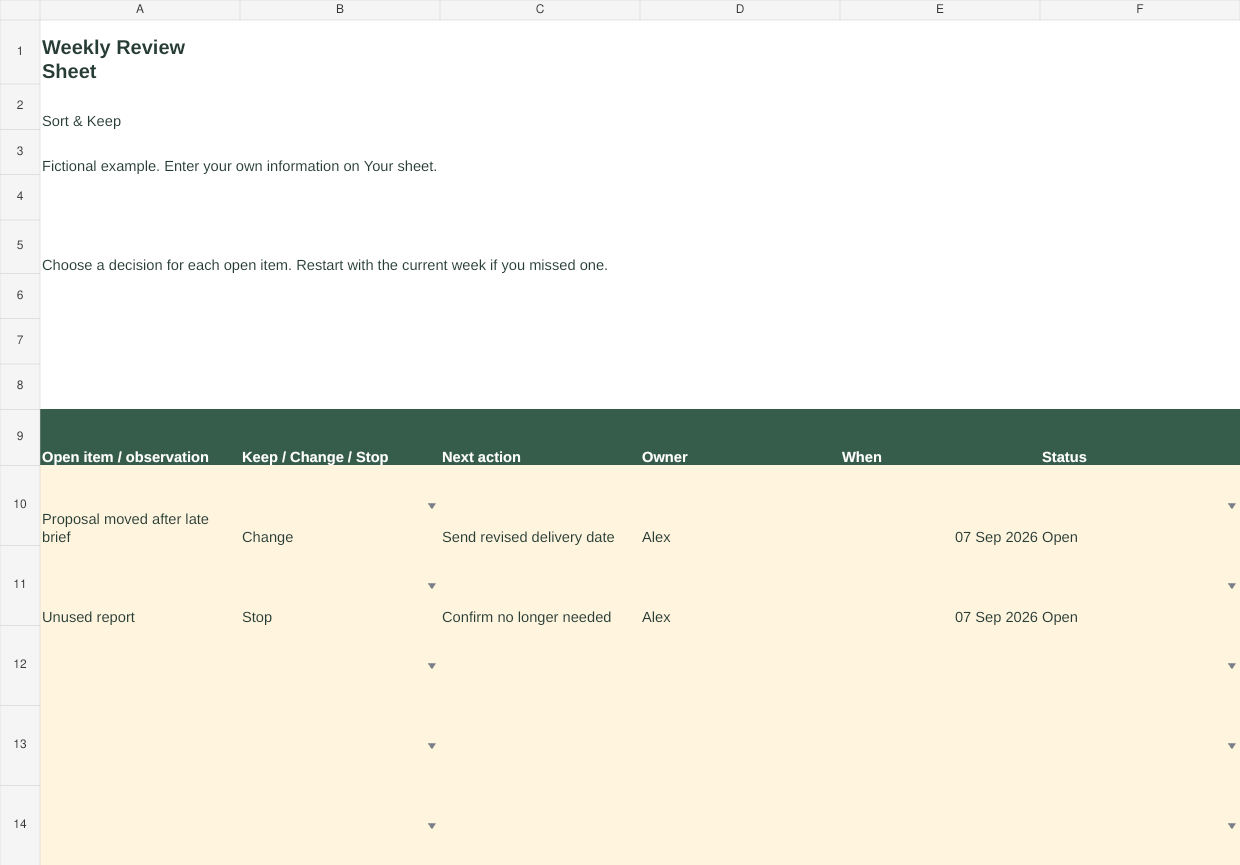
The free Weekly Review Sheet has space for a small set of decisions, an owner and a next action. You can put Keep, Change or Stop beside each item. It is deliberately not a points system: closing a difficult loop matters even if you completed fewer tasks than last week.
Choose a cue that already exists
Try attaching the review to a point you can recognise, such as after your final scheduled client session of the week. State where you will do it and what you will open. ‘After my Friday client call, I’ll open the review sheet at my desk’ is clearer than ‘be more organised’. If Friday is unreliable, choose another cue that fits your actual week.
In a University of Surrey interview, habit researcher Pippa Lally emphasises the value of specific plans and the wide variation in how long habits form. Her explanation challenges the idea that a fixed number of days guarantees a habit. That supports a patient approach to routines; it does not prove that a weekly spreadsheet review becomes automatic on a timetable.
Have a smaller version for difficult weeks
Your minimum review can be three lines: the most urgent open commitment, who needs an update, and the first action for the next working session. Save the wider review for a week when you have room. This is our practical suggestion for reducing the effort of returning, not a clinically tested intervention.
A fictional example: the proposal slipped because the brief arrived late. Decision: Change. Next action: send a revised delivery date on Monday. Another item is an unused reporting task. Decision: Stop. Next action: confirm with the client that the report is no longer needed. Those decisions are more useful than simply moving every unfinished item forward.
Restart from today
If you missed two reviews, open the current sheet and check the commitments that still matter. You do not have to fill in the missing weeks. Look at your calendar, the client follow-up tracker and any notes left on interrupted work. Move only the active commitments into the next weekly capacity plan.
If the same task keeps rolling forward, investigate the reason. It may be too vague, blocked, no longer important or larger than the time you have allowed. Change that condition before copying it into another week.
Use the whole series lightly
Start with the capacity plan to decide what fits. Use a restart note when leaving complex work. Keep waiting items in the follow-up tracker and home tasks in the home-admin list. Review the small number of decisions that connect them. You do not need all five tools every day. Keep the ones that reduce forgotten commitments and discard any step that creates more upkeep than value.
The example and blank workbook sheets are ready to use. If you enjoy a broader personal planning system, see Level Up Life Planner; the free review sheet remains useful on its own.
Sources and limits
- University of Surrey: Does it really take 66 days to form a habit?. 2026 interview with the original researcher. Habit formation varies widely; there is no guaranteed day count for adopting this weekly routine.
For a related next step, see Level Up Life Planner.