Grocery Budget Tracker Template: Cut Your Food Bill Smartly

Grocery budget tracker template to cut 20-30% off your food bill. Weekly spend logs, price tracking, and waste reduction tips. Get the template.

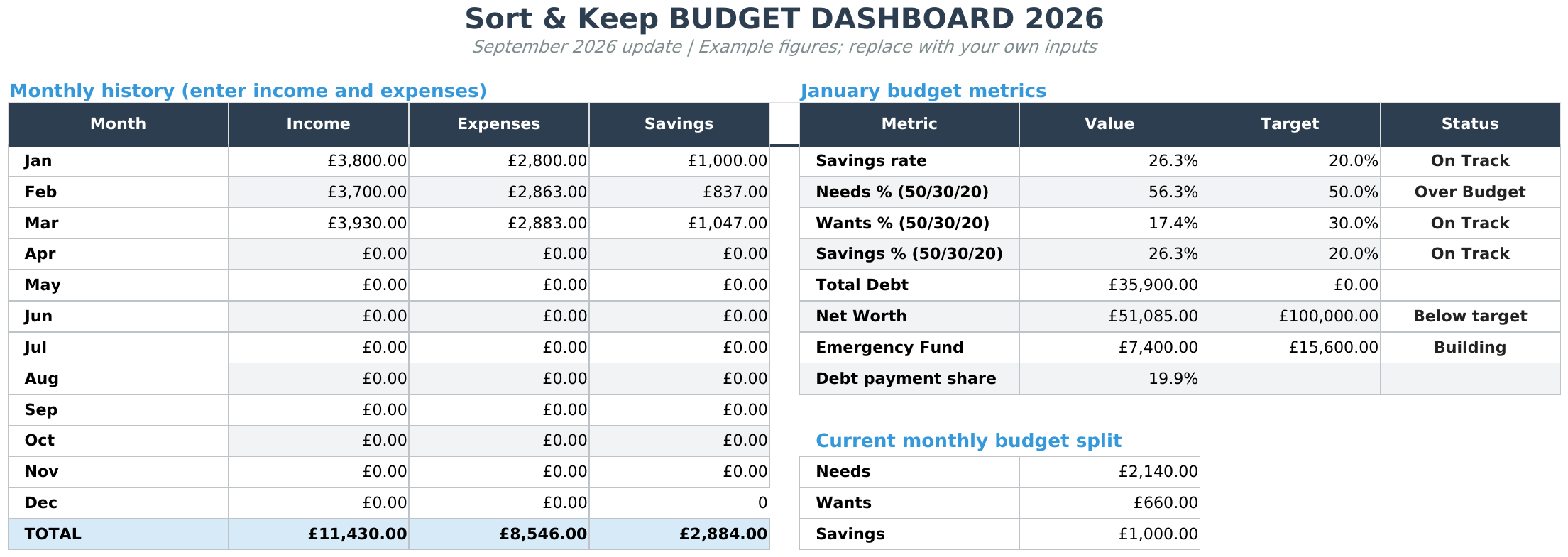
Dashboard with fictional example data from the September 2026 workbook
Actual September 2026 workbook · fictional UK example data

From Sort & Keep, the maker of the linked templates. Our current product prices update with your selected currency. Worked examples and third-party prices keep their stated currency and date.

UK grocery inflation hit 19.2% in March 2023. The highest rate in over 45 years. That peak has passed, but if you have noticed your weekly shop has not got cheaper since then, you are not imagining it. Prices rose sharply and stayed there. A grocery budget tracker is the only reliable way to see where your food money actually goes, and the average UK household spending roughly £97 per week on groceries has more room to cut than they think. We have seen people consistently save 20-30% once they start tracking properly. Without eating worse, without living on beans, and without spending Sunday afternoons clipping coupons.

The trick is that most people who "track" their grocery spending are not really tracking anything useful. They know the total. They do not know the breakdown. And the breakdown is where all the savings hide.


Why Your Budget App Says "Groceries: £400" and Tells You Nothing

Here is the problem with lumping everything into one "groceries" category. Which is exactly what most budgeting apps and bank statements do.

Your weekly Tesco shop contains at least four completely different types of spending:

Planned meals. The ingredients you actually went in for. Chicken thighs, rice, broccoli, tinned tomatoes. This is the spending you intended.

Impulse buys. The biscuits that were on offer, the fancy cheese you grabbed because it was end-of-aisle, the meal deal you picked up "for later" even though you have food at home. This is the spending you did not intend but barely noticed because it was mixed in with everything else.

Household items. Washing-up liquid, bin bags, kitchen roll, toiletries. Not food at all, but it goes on the same receipt and into the same budget category. At £15-20 per week, that is over £800 a year hiding inside your "food" budget.

Takeaways and convenience food. The Deliveroo on Wednesday when nobody felt like cooking. The ready meals that cost three times what the same dish would cost from scratch. These often come through a different payment method and do not even make it into the grocery total. They just vanish.

When your budget says you spent £400 on groceries last month, it is hiding all of this behind one number. You cannot optimise what you cannot see. The first step is not spending less. It is knowing what you are actually spending on.


The Grocery Budget Framework: Six Steps That Actually Work

Forget vague advice about "buying less." Here is a repeatable weekly framework that turns grocery spending from a guessing game into something you control.

Step 1: Set a Weekly Target

Take your current monthly grocery spend, divide by 4.3 (the actual number of weeks in a month, not 4), and that is your baseline. Now set your target 15% below it. Not 30%. That is too aggressive and you will quit by week three. A 15% reduction from £97/week is roughly £82/week, which saves over £780 per year. Start there and tighten later.

Step 2: Plan Meals Before You Shop

Meal planning is not about being rigid. It is about walking into a supermarket with a list instead of walking in hungry and improvising. Even a rough plan. "Monday pasta, Tuesday stir fry, Wednesday use up leftovers, Thursday chicken, Friday whatever is left". Cuts impulse spending by 25-40%.

Our Free Weekly Meal Planner | Also on Sort & Keep handles this if you want a template. Or use a whiteboard on the fridge. The format does not matter. The act of deciding before you shop is what matters.

Step 3: Generate a Shopping List From the Plan

If you know you are making bolognese, stir fry, and chicken traybake this week, you can write down exactly what you need. A list stops you forgetting things (no mid-week emergency top-up trips where you spend £25 on what should have been £4 of ingredients) and stops you buying things you do not need.

Step 4: Track Actual Spend Against Your Target

After each shop, log what you spent, where you shopped, and what you bought that was not on the list. The gap between your list total and your actual total is your impulse premium. For most people, this is 15-25% of the shop.

Step 5: Review Waste at the End of the Week

Open the fridge on Sunday. What went in the bin? Food waste costs the average UK household £60 per month according to WRAP. Over £700 a year in food you paid for and threw away. If you throw away rocket every single week, stop buying rocket.

Step 6: Adjust and Repeat

Each week, your tracker gives you data. Use it. If you are consistently over target because of mid-week top-ups, batch cook on Sunday to eliminate them. If impulse buys are always from the same store, switch to click-and-collect where there are no end-of-aisle temptations.


How to Build a Grocery Budget Tracker That Works

A proper grocery budget tracker needs four components. Most people only do the first one and wonder why it does not help.

Weekly Spending Log by Store

Track every grocery transaction: date, store, amount, and whether it was a planned shop or an unplanned top-up. Over a month, patterns emerge. You might discover you do one big Aldi shop for £55 but three Tesco Express top-ups for £12-18 each. Meaning the "quick trips" are costing you nearly as much as the main shop.

Per-Item Price Tracking Over Time

This is the one nobody does, and it is the most powerful. Pick your 20-30 most-bought staples and log the price every time you buy them. Over two to three months, you will catch price creep that is invisible on a single receipt.

We tracked semi-skimmed milk across four supermarkets over eight weeks. The price ranged from 95p to £1.35 for two litres. A 42% difference for the identical product. Chicken breast varied from £4.50/kg at Aldi to £7.80/kg at Waitrose. Everyone knows Aldi is cheaper. But knowing the exact per-kilo difference lets you decide which items are worth the trip.

Meal-to-Cost Linking

This is where your grocery tracker meets your meal plan. If you know Tuesday's stir fry cost £3.80 for four portions (95p per plate) and Thursday's chicken traybake cost £6.20 for four portions (£1.55 per plate), you can start making informed decisions about meal rotation. Not every meal needs to be the cheapest option. But knowing the cost lets you balance a £1 meal with a £3 meal instead of accidentally eating £3+ meals every night.

Waste Log

A simple three-column log: item, approximate cost, reason it was wasted. After four weeks, your waste log tells you exactly what to stop buying, buy in smaller quantities, or freeze immediately. It is unglamorous and slightly depressing, but it directly converts to savings.


5 Ways to Track Your Grocery Budget

The fanciest system in the world is worthless if you abandon it.


1. Pen and Receipt

Platform: Physical notebook + store receipts
Price: Free
Setup time: 5 minutes

The simplest possible system. Keep every receipt for a month. At the end of each week, sort them by store, total them up, and write the number in a notebook. Circle anything that was not on your list.

Pros:

  • Zero cost, zero technology required
  • Physically handling receipts makes spending feel real
  • Anyone can do this regardless of tech confidence
  • No subscription, no app permissions, no data sharing

Cons:

  • No automatic calculations. You are adding up receipts by hand
  • Receipts fade, smudge, and get lost in coat pockets
  • No per-item price tracking over time unless you are very dedicated
  • Cannot easily compare month-to-month trends

Verdict: Underrated starting point. If you have never tracked grocery spending before, a month of receipts in an envelope will teach you more about your habits than any app. Graduate to something digital once the habit is established.


2. Supermarket Loyalty App Data (Tesco Clubcard / Sainsbury's Nectar)

Platform: iOS, Android
Price: Free
Setup time: Already done if you have the card

Tesco Clubcard and Sainsbury's Nectar apps both show your purchase history with full itemised receipts. Tesco even categorises your spending and shows month-on-month trends. You are generating this data anyway. You might as well use it.

Pros:

  • Data is already being collected, no extra effort required
  • Itemised receipts mean you can track per-item prices over time
  • Tesco's spending findings show category breakdowns (fresh, frozen, household, etc.)
  • Clubcard prices effectively give you a 10-30% discount on selected items
  • Nectar points can be converted to spending money or Argos credit

Cons:

  • Only covers one store. Useless if you split shopping across Aldi, Lidl, and a supermarket
  • You are trading detailed purchase data for the convenience (read the privacy policy)
  • No integration with budgeting tools. You cannot export to a spreadsheet easily
  • Loyalty pricing can trick you into buying things you do not need because they are "on offer"

Verdict: Good as a supplementary data source if you already shop at Tesco or Sainsbury's. Not a complete tracking system because it only sees one store. The spending findings in the Tesco app are genuinely useful. Most people are surprised by how much of their "grocery" spend is actually household items and snacks.


3. Google Sheets or Excel Spreadsheet

Platform: Google Sheets, Excel, LibreOffice Calc
Price: Free (DIY) or £7.99 for a pre-built dashboard
Setup time: 30-60 minutes (DIY) or 10 minutes (pre-built)

A spreadsheet is the sweet spot between simplicity and power. You get automatic calculations, charts, historical comparison, and complete control over categories and layout. The downside is that somebody needs to build it. Or you use one that is already built.

Pros:

  • Full customisation. Track exactly what matters to you
  • Automatic totals, averages, and trend calculations
  • Historical data stays forever and is easy to compare across months
  • Works on any device (Google Sheets on phone, tablet, or laptop)
  • You own the data completely. No company can shut it down or change it

Cons:

  • Manual data entry after every shop (5-10 minutes per week)
  • Building a good one from scratch requires spreadsheet knowledge
  • No barcode scanning or receipt OCR
  • Easy to fall behind if you miss a week

Our Free Budget Tracker | Also on Sort & Keep handles the basics. For savings goals, debt tracking, and visual dashboards, the Budget Dashboard 2026 | Also on Sort & Keep (£7.99, one-time) adds those layers without a recurring subscription.

Verdict: Our top recommendation. The 5-10 minutes of data entry per week forces you to look at what you spent. Combine with the Free Weekly Meal Planner (Sort & Keep) for meal planning and budget tracking in one space for £0.


4. Budgeting Apps (YNAB / Emma / Plum)

Platform: iOS, Android, Web
Price: YNAB £6.99/month | Emma free (basic) or £4.99-9.99/month | Plum free (basic) or £2.99-9.99/month
Setup time: 15-20 minutes

These apps connect to your bank account and automatically categorise transactions. YNAB is the gold standard for intentional budgeting. Emma and Plum are popular UK alternatives with free tiers.

Pros:

  • Automatic transaction import. No manual entry
  • Real-time spending alerts when you approach your grocery budget limit
  • YNAB's "every pound has a job" philosophy is genuinely big
  • Emma and Plum have free tiers that handle basic categorisation

Cons:

  • YNAB costs £84/year. Significant if you are watching every pound
  • Automatic categorisation is imperfect. Deliveroo might appear as "groceries" or "restaurants" inconsistently
  • None of them handle per-item tracking. They see totals, not what you bought

Verdict: YNAB is excellent if you can justify the cost. It pays for itself if it changes your relationship with money, but £84/year is hard to recommend when free alternatives exist. Emma's free tier is decent for automatic categorisation. But none of these apps tell you what you bought, only what you spent. Which means they cannot help with per-item price tracking, meal-to-cost linking, or waste reduction.


5. Hybrid Approach (Our Recommendation)

Platform: Spreadsheet + loyalty app + meal planner
Price: Free to £7.99 one-time
Setup time: 20-30 minutes

Use the strengths of each system together. The loyalty app gives you itemised receipt data. The meal planner controls what you buy. The spreadsheet tracks weekly totals, per-item prices, and waste.

Pros:

  • Covers all four tracking components (spending log, price tracking, meal-cost linking, waste)
  • No ongoing subscription cost
  • Data stays in your control

Cons:

  • Three tools instead of one. Requires discipline to update weekly
  • Not a single-dashboard experience

Verdict: This is what we actually use. About 15 minutes per week. And it gives you information that no single tool provides on its own.


Money-Saving Tactics That Stack With Your Grocery Budget Tracker

Once you have tracking data, these tactics compound on top of each other. None of them require couponing, loyalty card hacking, or buying food you do not want to eat.

Price-Per-Unit Comparison

Supermarkets display price-per-unit on shelf labels, but they deliberately make it hard to compare. One product shows price per 100g, the one next to it shows price per kilogram. Your tracker should standardise everything to price per kilogram (or per litre for liquids).

Practical example: a 500g bag of Tesco own-brand pasta at £0.70 is £1.40/kg. A 1kg bag at £1.15 is £1.15/kg. 18% cheaper. Meanwhile, a "premium" 500g pasta at £1.85 is £3.70/kg. Nearly three times the cost. Is it three times better? Almost certainly not.

Seasonal Produce Over Year-Round Imports

British strawberries in June cost roughly £2-4/kg. In December, imported strawberries cost £6-8/kg and taste worse. The big seasonal wins in the UK: root vegetables (October-March), berries (June-September), courgettes and peppers (July-September), and apples (September-November). Out-of-season produce costs 2-3 times the in-season price for inferior quality.

Batch Cooking Cost Analysis

A slow cooker chicken stew that feeds four costs roughly £5-6 in ingredients. £1.25-1.50 per portion versus £3-4 for the ready meal equivalent. Batch cooking two meals on Sunday and freezing portions saves £10-15 per week for a household of four.

Your meal-to-cost tracker reveals which batch recipes give the best value. Our top performers: chilli con carne (£0.90/portion), lentil dal (£0.65/portion), pasta bake (£1.00/portion), and chicken stir fry (£1.10/portion). Normal dinners that happen to be cheap from scratch.

Store Switching by Category

No single supermarket wins on everything. Aldi/Lidl are typically 15-20% cheaper for staples, meat, and dairy. Tesco/Sainsbury's have better range and loyalty pricing can close the gap on selected items. Local greengrocers and market stalls are often cheapest for seasonal fruit and vegetables. Costco is only cheaper if you use the quantities before expiry. A 5kg bag of rice is excellent value, a catering-size tub of hummus is not.

Your per-item price tracker shows where each item is cheapest. Most people find a main shop at Aldi/Lidl plus a small targeted trip elsewhere saves 15-20% over doing everything at one supermarket.


What a Grocery Budget Tracker Reveals After 4 Weeks

After one month of proper tracking, you will know: your real weekly spend broken down by planned meals, impulse buys, household items, and convenience food. Which stores you overspend at. Your top 5 waste items and what they cost per month. Your average cost per meal. And whether your "grocery" budget is actually a grocery budget or whether £80/month of it is cleaning products and toiletries.

This is the information that lets you make a 20-30% cut without feeling deprived. You are not eating less or eating worse. You are buying less of what you throw away and more of what actually feeds your household well.


Our Recommendation

Start with what costs nothing and build from there.

This week: Download the Free Weekly Meal Planner | Also on Sort & Keep and plan five dinners before your next shop. Walk into the supermarket with a list. That single change typically saves 10-15% immediately.

This month: Start tracking weekly spend using the Free Budget Tracker | Also on Sort & Keep. Separate grocery spending into the four categories: planned meals, impulse buys, household items, and takeaways/convenience. The numbers will surprise you.

Ongoing: Add a waste log. Just a note on your phone. What went in the bin and roughly what it cost. After four weeks, you will have a clear list of items to stop buying, buy less of, or freeze immediately.

When you are ready: If you want savings goals, debt tracking, yearly overviews, and a visual dashboard to see your progress over months, the Budget Dashboard 2026 | Also on Sort & Keep (£7.99, one-time) gives you those features without a monthly subscription.

UK edition built for your kitchen. Portions in grams, ingredient names you'll recognise (courgette not zucchini, coriander not cilantro), and nutritional data from McCance and Widdowson. US edition included with USDA data and American measurements.

The average UK household can realistically save £1,000-1,500 per year on groceries with consistent tracking. Not by eating worse. By knowing where the money goes, cutting what does not add value, and making decisions based on data instead of habit. That is what a grocery budget tracker actually does.


Get free spreadsheet templates and updates. New templates, feature updates, and practical guides delivered to your inbox. No spam, unsubscribe anytime.

Subscribe free → | Already have a template? Download the free budget tracker or free meal planner. No email required.

Choose the right next step

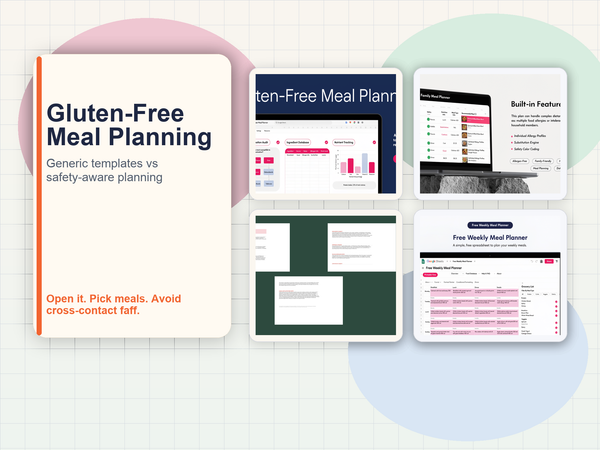
Start with the Free Weekly Meal Planner for a basic week and grocery list. For a dietary workflow, choose the gluten-free planner, vegan meal-prep planner, keto and low-carb planner, multi-allergy family planner. The Meal Planning Bundle puts all four specialist workbooks in one purchase.

UK, US and EUR editions are included where the workbook uses money. Training and habit workbooks use their existing editions.

Read more