
A lighter working week · Part 2 of 5
Interrupted again? Leave a useful note for your next working session
Make the stopping point useful
You are halfway through a client draft when a call starts. Later, you reopen the file and spend the first few minutes working out which version you were editing. A short restart note can preserve that context. It is especially useful when your day includes caring responsibilities, short working sessions or several clients. You do not need to record every interruption. Use it for work that would otherwise be hard to pick up.
Write four things before you switch
Record the task, where you stopped, the next physical action and any blocker. Include the file location or document title if finding the work will take effort. ‘Continue proposal’ is too vague. ‘Open Proposal v3, finish the exclusions paragraph below pricing, then check the delivery dates’ tells your future self where to begin.
If you have no time for four fields, write only the next action. A ten-word note you leave is more useful than a perfect system you skip. Keep confidential client details in your own controlled files; a link or short reference is often enough.
A worked example
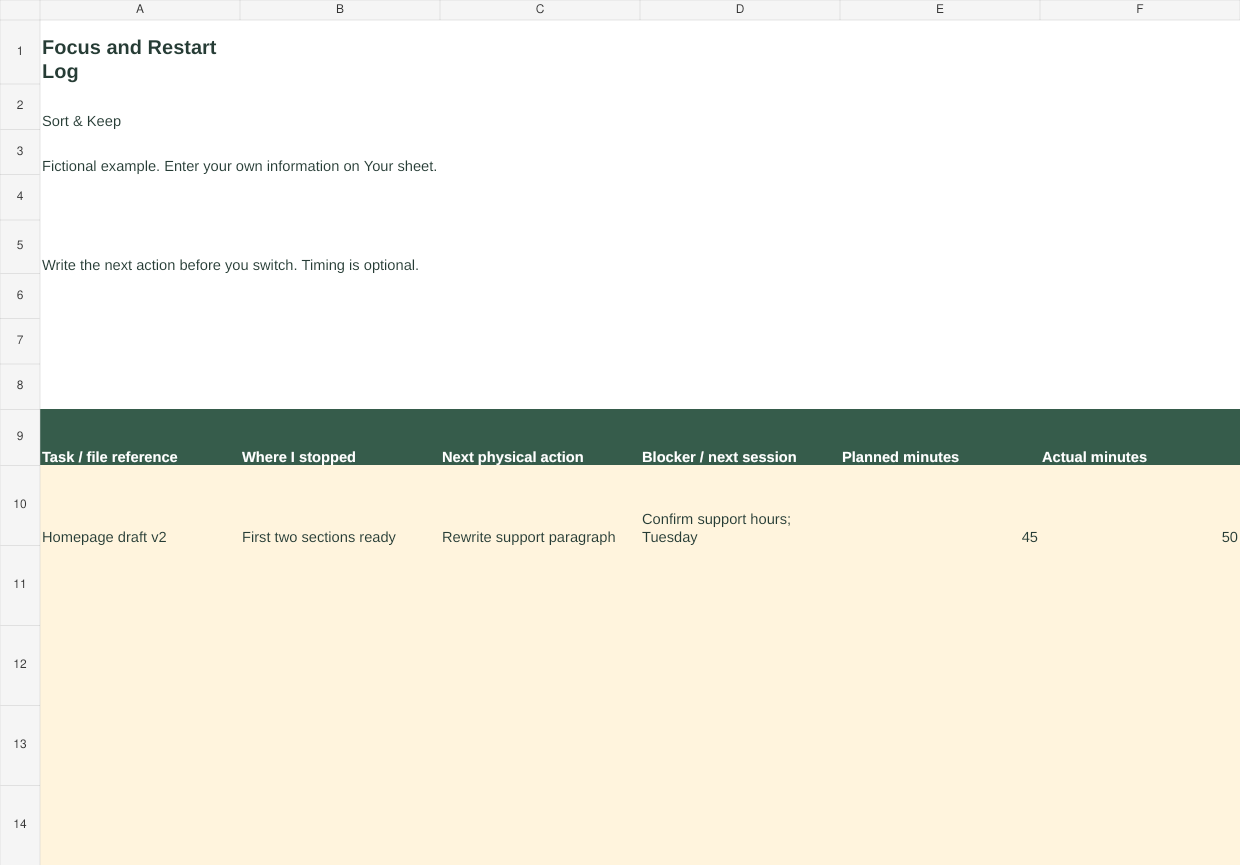
Fictional task: finish a homepage draft. Stopped at: first two sections approved internally; pricing paragraph still rough. Next action: open Homepage draft v2 and rewrite the paragraph beneath ‘Monthly support’. Blocker: waiting for the client to confirm the support hours. Next session: Tuesday morning. If that answer has not arrived, the next action becomes drafting the remaining section rather than repeatedly rereading the blocked paragraph.
The free log gives you a row for each working session. Planned and actual minutes are optional: use them if you want to understand your estimates. They are not a productivity score. A shorter session can still deliver the important next step.
What the research actually found
University of Washington reporting on Sophie Leroy and Theresa Glomb’s research describes how brief plans for resuming interrupted work reduced lingering attention to that work and helped performance on the new, interrupting task. The researchers studied several settings, including laboratory tasks. The report explicitly says the studies did not test whether the plan improved performance when returning to the original task. That distinction matters: our log is a practical way to retain context, not a promise of a measured improvement in restart speed.
Choose which interruptions need a response
Some interruptions are part of your work. A client reporting a broken checkout may need attention now. A routine query may wait until the response window you have agreed. Decide that boundary before the notification arrives where possible. Avoid turning focus into a rule that makes you unreliable to other people.
After switching, keep the note closed until you need it. If the log becomes another thing you constantly check, simplify it. One current row per task is enough for many people; you can mark earlier rows complete rather than maintaining a detailed history.
Try one session, then decide
Use the blank sheet for one task today. Before leaving, write the next action. When you return, check whether that note was specific enough to start. If it was not, add the missing detail next time. Keep the parts that help and leave the optional timing columns empty if they add work. The example tab shows a completed fictional entry so you can see the level of detail intended.
Sources and limits
- University of Washington: Task interrupted, a plan for returning helps you move on. 2018 university report of Leroy and Glomb’s studies. Benefits concerned attention and performance on the interrupting task; returning-task performance was not tested.
For a related next step, see Freelance Command Center.