Budget Template for Single Parents: One-Income Family Finance

Budget template for single parents. Track child benefit, maintenance, childcare costs, and school expenses on one income. Get the template.

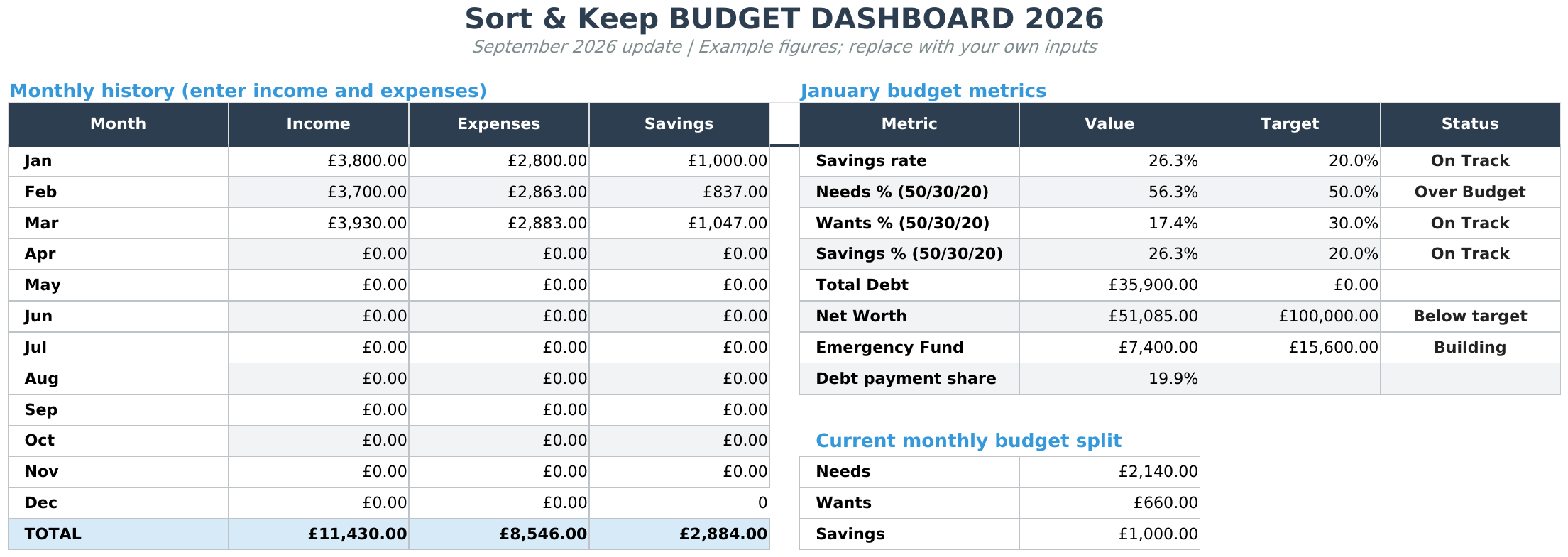
Dashboard with fictional example data from the September 2026 workbook
Actual September 2026 workbook · fictional UK example data

From Sort & Keep, the maker of the linked templates. Our current product prices update with your selected currency. Worked examples and third-party prices keep their stated currency and date.

Budgeting on a single income with children leaves no room for error. Childcare alone swallows 30-40% of take-home pay before you've paid rent, bought food, or put petrol in the car. One missed benefit payment or one surprise school trip invoice and the whole month collapses. Generic budget templates make this worse. They're built for two incomes and textbook expense splits that don't exist when nursery fees cost more than your mortgage.

This guide covers what a budget template for single parents actually needs, the tools worth using, and the features that make or break a single-income family budget. If you want to skip straight to a working system, the Budget Dashboard 2026 (£7.99, one-time) includes separate income lines for salary, benefits, and maintenance, plus a school cost calendar and savings tracker built around real single-parent expenses. Get it on Sort & Keep.


Why Generic Budget Templates Fail Single Parents

Most budget spreadsheets assume one scenario: income in, regular bills out, save what's left. Single-parent households don't work like that.

Here's what generic templates miss:

Child Benefit and Tax Credits. These are income. Often significant income. But they arrive on different schedules to your salary. Child Benefit is paid every four weeks (not monthly), and Universal Credit is assessed monthly but lands on a different date. A template with one "Monthly Income" field misses this entirely.

Maintenance payments. Whether you receive them reliably, sporadically, or not at all, maintenance from a co-parent needs its own tracking line. Budgeting as if payments will arrive when they're inconsistent is how months go wrong.

Childcare vouchers and Tax-Free Childcare. The government's Tax-Free Childcare scheme adds 20p for every 80p you pay in, up to £2,000 per child per year. But you need to actively pay into the account, and the top-up has a quarterly cap. If your template doesn't surface this, you're leaving free money unclaimed.

Irregular school costs. Uniforms in August. Book fairs in October. Christmas play costumes. World Book Day. School trips that somehow cost £45 for a coach to a museum 30 minutes away. These happen every year. They're invisible in a standard monthly budget.

Split custody expenses. If your children split time between two homes, costs don't halve. They redistribute unpredictably. You still need a full bedroom, a full fridge, and full school supplies at each address.

The 50/30/20 budget rule is a fine starting point, but those ratios break fast when childcare dominates. For many single parents, needs run 65-75% of take-home pay. That's not a discipline failure. It's the reality of raising children on one income.


The Single-Parent Budget Framework

Forget standard allocation percentages. Here's the framework that works for single-income families with children.

1. Fixed Essentials (Track to the Penny)

These are the bills that must be paid in full, on time, every month:

  • Rent or mortgage
  • Council tax
  • Utilities (gas, electric, water, internet)
  • Insurance (home, car, life)
  • Minimum debt payments
  • Phone contract

Target: Know this number exactly. It's your floor. Everything else builds on top of it.

2. Child Costs (The Non-Negotiable Variable)

This is the category generic templates ignore or lump into "needs":

  • Childcare or nursery fees
  • School meals (if not on free school meals. Check your entitlement)
  • After-school clubs
  • Nappies, formula, baby supplies (for younger children)
  • Children's clothing and shoes (budget monthly even if you buy quarterly)
  • School expenses fund (uniforms, trips, supplies. Divide annual cost by 12)

For context: the average full-time nursery place in England runs £14,000-£15,000 per year. Part-time childminders cost £6,000-£9,000. Even with the 15/30 free hours entitlement, wraparound care adds up fast.

Debt Payoff with fictional example data from the September 2026 workbook
Actual September 2026 workbook · fictional UK example data


Tracking every child cost as a separate line item. Nursery fees, school meals, uniforms, clubs. Nothing gets lost in a generic "kids" category.

3. Emergency Buffer (Non-Negotiable)

This is where single parents differ most from dual-income households. When there's no second income to fall back on, the emergency fund isn't optional. It's survival infrastructure.

  • Immediate target: £500 in an instant-access account (broken boiler, emergency car repair, week off with a sick child)
  • Medium-term target: One month's essential expenses (£1,500-£2,500 for most single parents)
  • Long-term target: Three months' essentials. Get here and you can sleep at night

Even £20/month into a buffer account changes your relationship with money. The goal isn't aggressive saving. It's stopping credit cards from becoming the emergency fund.

If you're carrying existing debt, a debt payoff tool can show whether snowball or avalanche gets you clear faster while still building that buffer. The Budget Dashboard 2026 includes both methods. Grab it for £7.99 on Sort & Keep.

4. Discretionary (What's Left)

Everything remaining after essentials, child costs, and buffer contributions. Food beyond basics, social life, treats for the kids, subscriptions, personal spending.

For many single parents, this number is small. Sometimes painfully small. That's honest. The point of the template isn't to pretend otherwise. It's to make sure every pound goes where it matters most, and to surface entitlements you might be missing.


5 Ways to Track a Single-Parent Budget

Here's what works and what doesn't when you're managing a single-income family budget.

1. Basic Google Sheets Spreadsheet (DIY)

Platform: Google Sheets (free)
Setup time: 30-60 minutes

Build your own using the framework above. Four tabs: Income (including benefits), Fixed Costs, Child Costs, and Monthly Summary.

Pros:

  • Free
  • Fully customisable to your exact situation
  • Works on phone and desktop
  • You understand every formula because you built it

Cons:

  • Takes time to set up properly
  • No automation. You're entering everything manually
  • Easy to break formulas if you're not spreadsheet-confident
  • No built-in reminders for benefit payments or renewals

Verdict: Good if you're comfortable with spreadsheets and have time upfront. Most people build one, use it for three weeks, then stop because manual entry gets tedious.


2. Emma (App)

Platform: iOS, Android
Price: Free tier available; Emma Pro from £4.99/month

Emma connects to your bank accounts and categorises transactions automatically. The free tier gives basic spending tracking; Pro adds budgets by category, savings goals, and bill tracking.

Pros:

  • Automatic transaction import saves time
  • Clean interface, works well on your phone
  • Bill reminders prevent missed payments

Cons:

  • Budgeting features need Pro (£4.99/month. Real money when budgets are tight)
  • No specific child cost or benefit tracking categories
  • Category auto-detection gets childcare wrong sometimes (lumps it with "shopping")

Verdict: Solid for automatic tracking if you can justify the Pro subscription. But you'll still need a separate system for benefit schedules and school costs. The lack of single-parent-specific categories means you're fighting the app's defaults.


3. Plum (App)

Platform: iOS, Android
Price: Free tier; Plum Pro from £2.99/month

Plum analyses your spending and moves small amounts to savings automatically. It also offers bill switching and basic budget tracking.

Pros:

  • Automatic savings feature is genuinely clever
  • Bill switching can find cheaper deals on utilities
  • Lower cost than Emma for the paid tier
  • Round-up feature turns spare change into savings

Cons:

  • Budget tracking is secondary to the savings feature
  • No detailed category breakdown for child expenses
  • Auto-saving can backfire if you're living close to zero. It might move money you need
  • Limited reporting and no spreadsheet export on the free tier

Verdict: Better as a savings tool than a budgeting tool. The auto-save feature helps once you have a stable budget, but can hurt when you're tight. Turn it off until your buffer is built, then let it work.


4. Government Benefit Calculators (EntitledTo / Turn2us)

Platform: Web (entitledto.co.uk, turn2us.org.uk)
Price: Free

Not budget templates, but essential tools. These calculators show every benefit and tax credit you're entitled to based on your income, children, housing costs, and work situation.

Pros:

  • Free and independent
  • Covers Universal Credit, Tax-Free Childcare, Council Tax Reduction, free school meals, Healthy Start vouchers, and more
  • Turn2us includes a grants search for one-off financial help

Cons:

  • Not a budget tracker. It's a one-off check
  • Results require you to apply for each benefit separately
  • Doesn't connect to any spreadsheet or app

Verdict: Every single parent should run these calculators at least twice a year. Once in April (new tax year) and once whenever circumstances change. We've seen people find £100-£300/month in unclaimed entitlements. That's not budgeting. It's found money.


5. Complete Spreadsheet Template (Pre-Built)

Platform: Google Sheets
Price: £7.99 one-time

A purpose-built spreadsheet with separate income lines for salary, benefits, and maintenance. Expense categories designed for families, savings goals with progress tracking, and a monthly dashboard.

Pros:

  • Ready to use in under 10 minutes
  • Designed for real budgeting scenarios, not textbook examples
  • Works on mobile via Google Sheets app
  • One-time cost, full control over categories

Cons:

  • Still requires manual data entry
  • No automatic bank connection or benefit reminders

The Budget Dashboard 2026 (£7.99, one-time) covers everything: income tracking with separate lines for benefits and maintenance, savings goals, debt payoff, a proper dashboard, and yearly overview. It works especially well for single parents because you can shape categories around child costs without fighting an app's preset structure. Get it on Sort & Keep.

Monthly Budget with fictional example data from the September 2026 workbook
Actual September 2026 workbook · fictional UK example data


The spending summary breaks expenses into categories. Making it easy to see exactly how much goes to childcare, school costs, and essentials each month.

Verdict: Best balance of structure and flexibility for single parents. You get a working system immediately but can adapt it to your exact situation. Irregular maintenance payments, benefit schedules, school cost calendars, all of it.


Single-Parent-Specific Features That Matter

Whatever tool you choose, your system needs these. They're the difference between a generic budget and one that actually works on a single income with children.

Child Benefit Tracking

Child Benefit is paid every four weeks, not monthly. Some months you get one payment; others you get two. Map out which months get the extra payment. Over a year, you'll receive 13 payments, not 12. That "extra" payment is worth planning around. Good month to top up the emergency fund or pre-pay a school expense.

Maintenance Payment Logging

If you receive maintenance, log every payment with the date and amount. Over six months, you'll see the real pattern. Consistent, late, or declining. This matters for two reasons: adjusting your budget to match actual (not promised) payments, and having a record if you ever need to go through the CMS.

School Cost Calendar

Plot every known school expense across the year:

  • September: Uniform, shoes, PE kit, school bag
  • October-November: Book fair, Harvest festival, fireworks trip
  • December: Christmas play costume, class party contribution, teacher gifts
  • March: World Book Day costume, Mother's Day crafts
  • May-July: Sports day, summer trip, end-of-year gifts

Divide the total by 12 and save that amount monthly. A £40/month school cost fund stops September from being a financial crisis every year.

Childcare Cost Comparison

If your children are under school age, compare nursery vs. Childminder vs. Nanny share annually. Factor in the 15/30 free hours entitlement (hourly rates vary significantly between providers), Tax-Free Childcare top-ups, and the effect on your Universal Credit calculation (childcare costs can increase your UC entitlement). A £50/month saving on childcare is £600/year. The right spreadsheet makes this comparison visible.

The Budget Dashboard 2026 includes a built-in comparison section for exactly this.

Benefit Entitlement Reminders

Re-check your entitlements in April (new tax year, thresholds change), September (free school meals eligibility, saves around £400/year per child), whenever your income or hours change, and quarterly for Tax-Free Childcare top-ups (use it or lose the government contribution for that quarter).


The Template That Surfaces Money You're Missing

Here's the honest truth about budgeting as a single parent: the right template doesn't just track where money goes. It surfaces money you're not getting.

We've seen single parents pick up £150/month in unclaimed Tax-Free Childcare top-ups. Others found they qualified for Council Tax Single Person Discount (25% off, and around 1.5 million eligible people don't claim it). Some discovered entitlement to free school meals, Healthy Start vouchers, or the Sure Start Maternity Grant without knowing.

A good budget template forces you to list every income source, which makes gaps visible. "Am I getting everything I'm entitled to?" becomes an answerable question instead of a vague worry.

If you're co-parenting and splitting some costs, our budget template for new parents includes a proportional split calculator that works for shared child expenses too.


Getting Started

You don't need the perfect system. You need one you'll actually use past week two.

  1. Run the EntitledTo or Turn2us calculator today. Fifteen minutes, and it might find you money.
  2. Fill in your actual numbers. Income, benefits, maintenance, every fixed cost.
  3. Break out child costs as separate line items: childcare, school meals, uniforms, clubs, clothing.
  4. Plot the school cost calendar so nothing blindsides you.
  5. Build the buffer. Even £10/month. Start.

The Budget Dashboard 2026 (£7.99 once, no subscription) handles all of this out of the box. Savings goals, debt payoff tracking, a proper dashboard, and categories built around real single-parent finances. Not a recurring fee eating into the budget you just built. Get it on Sort & Keep.

UK edition built for British finances. HMRC Self Assessment categories, council tax tracking, National Insurance calculations, ISA allowances, and GBP formatting throughout. US edition included with IRS tax brackets, 401(k) tracking, and USD formatting.

The numbers might be tight. They probably are. But knowing exactly where every pound goes, and making sure you're getting every pound you're entitled to, is how single parents turn a stressful situation into a manageable one.


Get free spreadsheet templates and updates. New templates, feature updates, and practical guides delivered to your inbox. No spam, unsubscribe anytime.

Subscribe free | Already have a template? Download the free budget tracker or free meal planner. No email required.

Choose the right next step

Need a simple budget tracker spreadsheet? Start with the Free Budget Tracker. Use Budget Dashboard 2026 when you want budgets, debt, savings and net worth in one workbook. Choose the Complete Collection when several parts of life admin need sorting.
UK, US and EUR editions are included where the workbook uses money. Training and habit workbooks use their existing editions.

Read more