Bi-Weekly Budget Template: Budget by Paycheck, Not by Month
Bi-weekly budget template for 26 paychecks per year. Includes bonus paycheck strategy and step-by-step setup. Get the template.

From Sort & Keep, the maker of the linked templates. Our current product prices update with your selected currency. Worked examples and third-party prices keep their stated currency and date.
If you get paid every two weeks, monthly budgets have been lying to you. A proper bi-weekly budget template helps you plan around your actual pay dates. With fortnightly pay, some months have three paydays. Put those dates into the calendar and assign the money to the costs it needs to cover.
We built our finances around bi-weekly pay for years before realising the mismatch. Every January, we'd divide annual salary by 12 and wonder why some months felt tight and others felt flush. The answer was simple: our income didn't arrive monthly, so budgeting monthly was the wrong frame.
Why Monthly Budgets Fail Bi-Weekly Earners
Your bills are monthly. Your income is bi-weekly. These two cycles never align, and forcing them together creates three problems.
Artificial cash flow crises. If rent is due on the 1st and your paycheck lands on the 3rd, you're short for three days every other month. A monthly budget says you have enough. The timing says you don't. This is how people with solid incomes end up overdrafting.
The invisible bonus months. In 2026, bi-weekly earners on a Friday pay schedule get three paychecks in May and October. If your take-home is £1,600 per paycheck, that's an extra £1,600 twice a year. £3,200 total. A monthly budget averages your income to £3,467/month (£1,600 x 26 / 12), absorbing that bonus into everyday spending. You never deploy it strategically. It just evaporates.
Bill assignment chaos. Which paycheck pays the mortgage? Which covers car insurance? Monthly budgets don't answer this. Living on bi-weekly pay demands it. Because paycheck 1 and paycheck 2 carry very different obligations.
The 50/30/20 rule is solid, but it assumes steady monthly income. Bi-weekly earners need a system built around their actual pay cycle.
The Bi-Weekly Budget Framework
Stop budgeting by month. Budget by paycheck.
Assign Every Bill to a Specific Paycheck
Split monthly expenses across your two regular paychecks based on when bills are due.
Paycheck 1 (1st-14th): Rent £950, council tax £165, car insurance £85, internet £45, groceries £150. Total: £1,395.
Paycheck 2 (15th-end): Utilities £130, phone £35, streaming £30, groceries £150, transport £120. Total: £465.
On a £1,600 take-home, paycheck 1 is tight (£205 remaining) and paycheck 2 is comfortable (£1,135 remaining). That imbalance is fine. You're not aiming for equal splits. You're making sure every bill is covered by the paycheck that arrives before its due date.
Handle the Remaining Money
After fixed bills, allocate what's left per paycheck to savings (aim for £150-200), debt payments above minimums, discretionary spending, and sinking funds (holiday, gifts, car MOT). Each paycheck is its own budget. Don't borrow from paycheck 2 to cover paycheck 1.
The Bonus Paycheck. Two Months Per Year
Two months per year, a third paycheck lands. Since all bills are already assigned to paychecks 1 and 2, that third paycheck has zero obligations. It's entirely surplus. And it's where bi-weekly budgeting becomes powerful.
Step-by-Step: Bi-Weekly Budget Template in Google Sheets
Step 1: The 26-Paycheck Annual View
On the first tab, list all 26 paychecks for the year: paycheck number, date, gross, net take-home, and type (Regular or Bonus). Auto-generate dates with =B2+14 and copy down. Use conditional formatting to highlight the two bonus paychecks in green. You'll spot them immediately.
Step 2: Per-Paycheck Expense Assignment
On a second tab called "Paycheck Budget," create a simple table:
| Expense | Paycheck 1 | Paycheck 2 |
|---|---|---|
| Rent / Mortgage | 950 | |
| Council Tax | 165 | |
| Car Insurance | 85 | |
| Internet | 45 | |
| Utilities | 130 | |
| Phone | 35 | |
| Streaming | 30 | |
| Groceries | 150 | 150 |
| Transport / Fuel | 120 | |
| Total Fixed | =SUM | =SUM |
| Take-Home | 1,600 | 1,600 |
| Available After Bills | =Take-Home minus Total | =Take-Home minus Total |
The "Available After Bills" row is the number that matters. It's what you can allocate to savings, debt, and spending.
Step 3: Bill Due-Date Alignment
On a third tab, map every bill to its due date and assigned paycheck. The rule: assign each bill to the paycheck arriving before the due date. Check this monthly. 26 paychecks don't land on the same dates every month, so assignments may shift.
Step 4: Bonus Paycheck Planner
On a fourth tab, plan the two bonus paychecks. List the months they fall in, the amount, and your allocation. Emergency fund, debt payoff, investments, annual expenses. Decide in January, not when the money lands.
Bi-Weekly Budget Templates and Tools: Options to compare
We evaluated five approaches. Most tools bolt on bi-weekly support as an afterthought. Here's what actually works.
1. Sort & Keep Free Budget Tracker
Platform: Google Sheets | Price: Free
Our free budget tracker (Sort & Keep) includes income tracking, expense categories, and a summary dashboard. It's monthly by default, but easy to adapt. Duplicate the budget tab twice (one per paycheck) and relabel.
Pros: Free, clean layout, no email wall, works on any device
Cons: Monthly by default, no 26-paycheck view, manual entry
Verdict: The fastest free starting point. Fifteen minutes of adaptation gives you a working bi-weekly budget. Get the free budget tracker | Also on Sort & Keep.
2. Sort & Keep Budget Dashboard 2026
Platform: Google Sheets | Price: $10.81 one-time
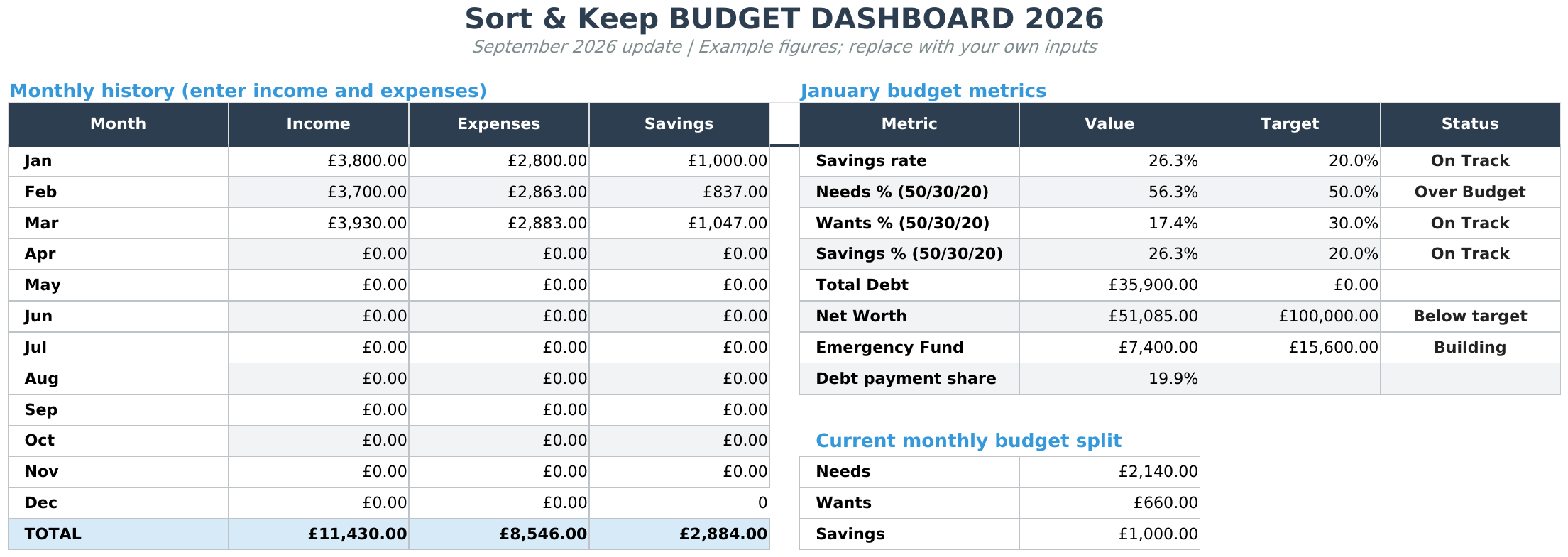
The Budget Dashboard 2026 (Sort & Keep) is the full system. Income tracking, expense breakdown, savings goals, debt payoff (snowball and avalanche), net worth monitoring, and a visual dashboard.
UK edition built for British finances. HMRC Self Assessment categories, council tax tracking, National Insurance (Class 2 and Class 4) calculations, ISA allowances, and GBP formatting throughout. US edition included with IRS tax brackets, 401(k) tracking, and USD formatting.
Pros: Annual and monthly views, debt payoff tracker, net worth tracking, savings progress bars, $10.81 one-time
Cons: Monthly framework you'll adapt per-paycheck, Google Sheets only, manual entry
Verdict: Best value for bi-weekly earners who want more than a basic tracker. The annual view helps spot bonus months, and the debt/savings tools give those bonus paychecks somewhere productive to go. Get the Budget Dashboard 2026 | Also on Sort & Keep.
3. Goodbudget (Envelope Budgeting)
Platform: Web + iOS + Android | Price: Free (basic) / $10/month (Plus)
Goodbudget's envelope method is a natural fit for bi-weekly pay. Fill envelopes when you get paid, stop spending when the envelope is empty. You can schedule fills to match your pay dates.
Pros: Envelope system fits per-paycheck budgeting naturally, syncs across devices, free tier covers 10 envelopes
Cons: Free tier is limited, $10/month adds up to £120/year, no bank sync, basic reporting
Verdict: The best conceptual match for bi-weekly budgeting. Worth trying the free tier before committing to paid.
4. YNAB (You Need a Budget)
Platform: Web + iOS + Android | Price: $14.99/month or $109/year
YNAB's philosophy. "give every dollar a job". Is zero-based budgeting applied to each payday. Start with the money received and list the outgoings it needs to cover.
Pros: Built for paycheck-based budgeting, bank syncing, excellent reporting, goal tracking
Cons: £180/year is steep, 2-3 month learning curve, your data lives in their system
Verdict: The best dedicated app for bi-weekly budgeting. The question is whether £180/year for budgeting software makes sense when a one-time spreadsheet gets you 80% there.
Price Comparison
| Tool | Price | Bi-Weekly Native | Bank Sync | Best For |
|---|---|---|---|---|
| Free Budget Tracker | Free | Adaptable | No | Quick start |
| Budget Dashboard 2026 | $10.81 one-time | Adaptable | No | Best value |
| Goodbudget | Free / $10/month | Yes | No | Envelope fans |
| YNAB | $14.99/month | Yes | Yes | Best app |
The Bonus Paycheck Strategy
Those two extra paychecks. £3,200 on a £1,600 take-home. Are the biggest advantage of bi-weekly budgeting. But only with a strategy decided before the money lands.
Option 1: Pretend It Doesn't Exist
Set up an automatic transfer to savings for the full bonus paycheck amount. At year-end, you'll have £3,200 saved with zero willpower required. Behavioural design beats motivation every time.
Option 2: Cover Annual Expenses
Some bills hit once or twice a year and destroy monthly budgets: car insurance (£600), MOT and service (£300), Christmas gifts (£400), holiday fund (£800), home insurance (£250), annual subscriptions (£150). That's £2,500. Fully covered by bonus paychecks with £700 left for savings. Those annual expenses stop being emergencies.
Option 3: Split Between Debt and Savings
Divide each bonus paycheck 50/50. On £1,600, that's £800 to debt and £800 to savings per bonus month. Over a year: £1,600 extra on debt (saving roughly £350 in interest on a credit card at 22% APR) and £1,600 into savings. If you're debt-free, £3,200/year into an ISA earning 7% grows to over £44,000 in ten years. Built from paychecks your monthly budget never knew existed.
For modelling the debt impact, our debt payoff calculator handles bonus contribution scenarios.
Common Mistakes with Bi-Weekly Budgeting
Averaging income monthly. Dividing annual salary by 12 gives you a number that doesn't match 10 out of 12 actual months. Budget based on two paychecks. The bonus months handle themselves.
Not checking pay date alignment. Your paychecks don't land on the same dates every month. A bill safely covered by paycheck 1 in March might fall before paycheck 1 in April. Check each month and adjust.
Treating bonus paychecks as spending money. This is how the £3,200 advantage disappears. Assign the bonus paycheck a job before it arrives. Savings, debt, or annual expenses. Decide in January.
Over-complicating the system. Two paycheck budgets, a due date reference, and a bonus paycheck plan. That's the whole system. If maintaining it takes more than 10 minutes per paycheck, simplify.
Final Recommendation
If you earn bi-weekly, stop using monthly budgets. The timing mismatch creates unnecessary stress, and you're leaving £3,200/year on the table by averaging your income.
Start with the free budget tracker | Also on Sort & Keep, adapt it for per-paycheck budgeting using the framework above, and try it for two months. Here is the full picture. Debt tracking, savings goals, net worth, and a visual dashboard. The Budget Dashboard 2026 | Also on Sort & Keep is $10.81 one-time. Less than half of one month of YNAB.
Use actual pay dates to plan upcoming bills. Include every payday in the calendar, including months with three payments.
Twenty-six paychecks per year. Two of them are yours to deploy strategically. Don't let a monthly template average them away.
Related Reads
- Envelope Budget Spreadsheet: Digital Cash Envelopes in Google Sheets
- Bill Tracker Spreadsheet: Never Miss a Payment
- Zero-Based Budget Template
- Budget Spreadsheet Templates 2026: Compare Free and Paid Options
Get free spreadsheet templates and updates. New templates, feature updates, and practical guides delivered to your inbox. No spam, unsubscribe anytime.
Subscribe free → | Already have a template? Download the free budget tracker or free meal planner. Email required for delivery; newsletter optional.
Choose the right next step
Need a simple budget tracker spreadsheet? Start with the Free Budget Tracker. Use Budget Dashboard 2026 when you want budgets, debt, savings and net worth in one workbook. Choose the Complete Collection when several parts of life admin need sorting.