Budget Template for UK Immigrants: Tax, Benefits & Banking
Budget template for UK immigrants covering PAYE tax, National Insurance, council tax, and visa costs. Get the template.

From Sort & Keep, the maker of the linked templates. Our current product prices update with your selected currency. Worked examples and third-party prices keep their stated currency and date.
Moving to the UK can mean learning new payment schedules and record-keeping requirements. Use confirmed costs and your own statements to build the plan. A budget template for immigrants UK needs to account for all of this, because a generic spreadsheet built for someone who grew up here will miss half of what actually matters to your finances.
We built this guide for people who have moved to the UK and need to understand how money works here; in practice, not theory. What gets deducted from your payslip. What bills arrive that you have never heard of. And how to build a budget that reflects your actual life, including the parts most templates ignore: visa fees, remittances home, and the premium you pay for having no UK credit history.
Why Your Home-Country Budget Does Not Transfer
You might have been excellent with money back home. That does not matter here.
The cost-of-living shock is real. Average monthly rent for a one-bedroom flat in London is around £1,800. Outside London it drops to £700-£1,000, but that still catches people off guard. Add groceries at £200-£350/month, utilities at £100-£180, and a mobile contract at £15-£30, and your first month will almost certainly exceed estimates.
Currency adjustment distorts everything. You might earn £30,000 and think "that is a lot" because converted to your home currency, it sounds enormous. But you are spending in pounds. The conversion is irrelevant for day-to-day budgeting; what matters is whether £30,000 covers your actual UK costs.
Visa fees are ongoing, not one-off. A Skilled Worker visa costs £719-£1,420. The Immigration Health Surcharge (IHS) is £1,035 per year per person; a family of three pays £3,105 annually just to access the NHS. Indefinite Leave to Remain costs £2,885. Citizenship costs £1,580. These are recurring costs that need a budget line for the next 5-10 years.
No credit history means higher costs. Providers may ask for records of your income, address or credit history. Check their requirements before applying and include any confirmed upfront costs in your budget.
Remittances eat into take-home pay. A bank transfer home might cost £25 plus a 3-4% exchange rate markup, while Wise charges 0.5-1.5%. On a £500 monthly remittance, the difference is £150-£200 per year.
How UK Income Actually Works: PAYE and National Insurance
Your first payslip will be confusing. Here is what happens to your money before it reaches your bank account.
PAYE (Pay As You Earn) is the UK's income tax system; your employer deducts tax before paying you. The 2025/26 bands: 0% on the first £12,570 (Personal Allowance), 20% on £12,571-£50,270, 40% on £50,271-£125,140, 45% above that. On a £30,000 salary, that is £3,486/year in income tax (£290.50/month).
Critical for immigrants: emergency tax codes. When HMRC does not have your details, your employer may use an emergency code (often "0T" or "BR"), meaning you get no Personal Allowance or pay a flat 20% on everything. You will be overtaxed by hundreds of pounds per month. Check your payslip for the tax code; it should say "1257L." If it says "0T," "BR," or has "W1/M1" appended, contact HMRC on 0300 200 3300 immediately.
National Insurance (NI) is a separate deduction funding the State Pension and NHS. Employees pay 8% on earnings between £12,570 and £50,270. On £30,000, that is £1,394/year (£116/month). You need 10 qualifying years of NI to receive any State Pension and 35 years for the full amount (£221.20/week).
Your actual take-home on £30,000: after £3,486 income tax and £1,394 NI, you receive £25,120/year; £2,093/month. That is 83.7% of your gross salary. Budget on £2,093, not £2,500.
The New-to-UK Budget Framework
Here is a framework designed specifically for immigrants, ordered by priority.
Layer 1: Income after PAYE + NI. Start with your actual take-home pay. If you are on an emergency tax code, budget on the reduced amount and treat the eventual refund as a bonus.
Layer 2: Essential UK costs. Rent (£700-£1,800/month), council tax (£100-£250/month), utilities (£100-£180/month), groceries (£200-£350/month), transport (£50-£200/month), mobile (£15-£30/month).
Layer 3: Visa and immigration costs. Set aside money monthly for future lump sums:
| Cost | Amount | Monthly Set-Aside |
|---|---|---|
| IHS (annual, per person) | £1,035 | £86.25 |
| Visa renewal (3-year Skilled Worker) | £1,423 | £39.53 |
| ILR application | £2,885 | £48.08 |
At minimum, budget £125-£175/month for immigration costs. For a couple, double it.
Layer 4: Remittances. If you send money home, treat it as a bill, not discretionary spending.
Layer 5: Emergency fund. Three months of essential costs. Even £50/month builds a buffer.
Layer 6: Building UK credit. Allocate £20-£50/month to a credit-building strategy; more on this below.
Budget Template for Immigrants UK: Options to compare
We evaluated five approaches with specific attention to immigrant needs: PAYE comprehension, visa cost planning, remittance tracking, and credit building.
1. Pen and Paper / Notes App
Platform: Physical notebook or phone notes
Price: Free
Best for: Your first 1-2 months when everything is new
When you first arrive, just write everything down. Every purchase, every bill, every transfer home. Do not try to categorise; just capture.
Pros: Zero cost; works in any language; forces awareness of UK prices
Cons: No calculations or trends; cannot handle visa cost planning over months; easy to abandon
Verdict: Good for month one. Not a long-term solution.
2. Banking Apps (Monzo / Starling)
Platform: iOS, Android
Price: Free
Best for: Immigrants who want real-time spending visibility
Monzo and Starling are significantly easier to open than high-street banks when you are new to the country; Monzo requires only a valid passport and a UK address (even temporary). Both offer spending categorisation, instant notifications, and "pots" to ring-fence money for rent, bills, visa savings, and remittances.
Pros: Easy account opening without UK credit history; real-time spending alerts; pots separate your money by purpose; free
Cons: No "Visa Fees" or "Remittances" category; not a budgeting tool; shows what you spent, not what you should spend
Verdict: Open one as soon as you arrive. It solves the "I need a UK bank account" problem faster than any high-street bank. But you still need a separate budgeting tool.
3. YNAB (You Need A Budget)
Platform: Web + mobile
Price: $14.99/month
Best for: Immigrants with stable income who can justify the cost
YNAB's envelope method; every pound gets assigned a job; maps well to the layered framework above. Custom categories let you create "Visa Renewal," "IHS Surcharge," and "Remittances." Goal tracking handles large future expenses like ILR.
Pros: Best budgeting methodology available; custom categories; bank syncing with UK banks
Cons: $14.99/month (£142/year) is steep when you are also paying £1,035/year IHS; single currency only; learning curve, especially if English is not your first language
Verdict: The best pure budgeting tool, but hard to justify the cost for someone also saving for a £2,885 ILR application. The methodology is worth learning even if you apply it in a free spreadsheet.
4. Free Budget Spreadsheet
Platform: Google Sheets
Price: Free
Link: Free Budget Tracker | Also on Sort & Keep
A pre-built spreadsheet with income tracking, expense categories, and monthly overview. For immigrant use, rename categories to match your reality: add "Visa/IHS Savings," "Remittances," "Credit Building" as expense lines. Add a second tab for visa cost planning with dates and amounts.
Pros: Completely free; works on any device; fully customisable categories; shareable with a partner
Cons: Manual data entry; no built-in PAYE calculator; basic design
Verdict: The best starting point for most immigrants. It costs nothing and can be customised to include every immigrant-specific category. Start here.
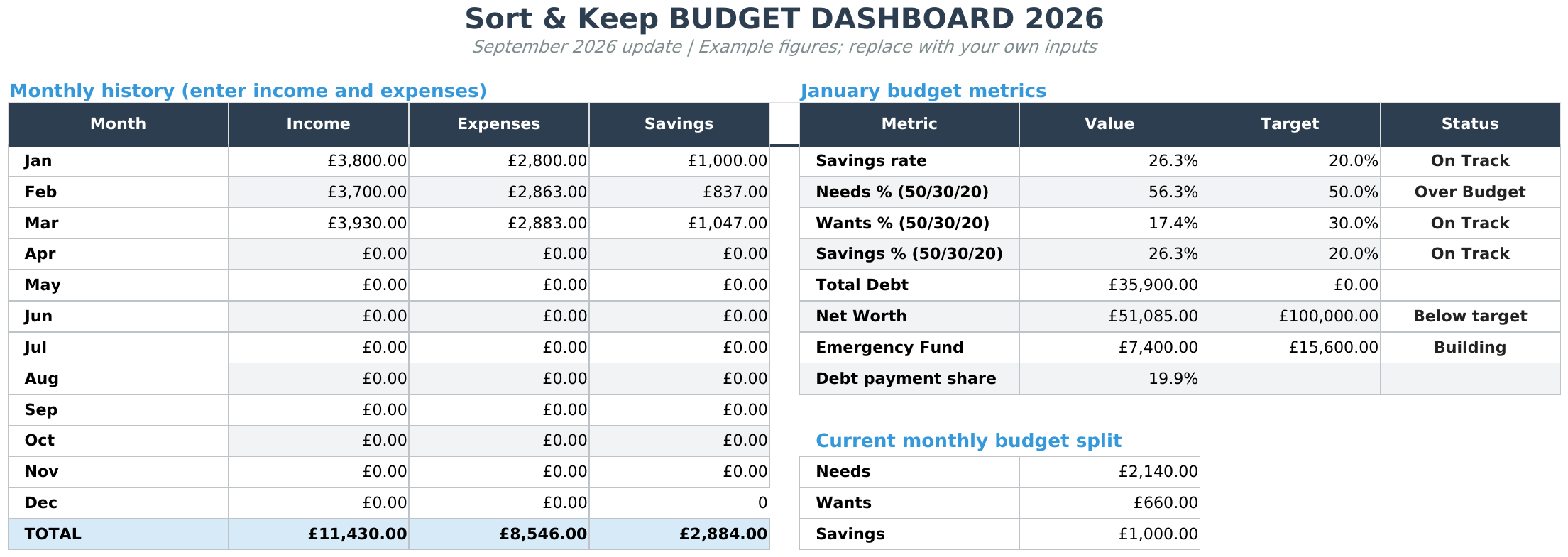
5. Budget Dashboard With Immigrant Customisation
Platform: Google Sheets
Price: $10.81 (one-time)
Link: Budget Dashboard 2026 | Also on Sort & Keep
UK edition built for British finances. HMRC Self Assessment categories, council tax tracking, National Insurance (Class 2 and Class 4) calculations, ISA allowances, and GBP formatting throughout. US edition included with IRS tax brackets, 401(k) tracking, and USD formatting.
Everything in the free version plus savings goals, debt tracking, a visual dashboard, and a yearly overview. The yearly view lets you see total visa costs across 12 months, compare remittance spending month to month, and watch your emergency fund grow.
Pros: One-time cost; savings goals with progress bars (set one for ILR, one for emergency fund); debt tracking for relocation expenses; yearly view shows seasonal patterns
Cons: $10.81 is still money when watching every pound; manual data entry
Verdict: Best value for immigrants who plan to stay long-term. The free tracker (Sort & Keep) handles the first few months. The Dashboard (Sort & Keep) handles the long game; at $10.81 once, it costs less than a single month of YNAB.
Features a Budget Template for Immigrants UK Must Include
PAYE Tax Code Checker
Your tax code determines how much tax you pay. The standard 2025/26 code is 1257L (£12,570 tax-free). If yours says 0T, BR, or has W1/M1 appended, you are being overtaxed. Check at gov.uk/check-income-tax. Log expected refunds in your budget but do not spend them until they arrive.
Council Tax Explained
Council tax is a local government charge based on the property you live in, not your income. Typical bills: £1,200-£2,500/year. Things immigrants often do not know:
- You must register yourself. Contact your local council when you move in.
- Single Person Discount: 25% off if you live alone.
- Council Tax Reduction: Up to 100% off if you are on a low income; separate from Single Person Discount and means-tested.
- Paid over 10 months by default (April-January). Request 12-month payments to reduce the monthly amount.
- Missing payments is serious. Councils add court costs (typically £90) and can send bailiffs.
Visa Renewal Cost Planner
A single person on a 5-year path to ILR will spend roughly £8,000-£10,000 on immigration costs. A couple: £16,000-£20,000. Build a timeline, divide by months, and save accordingly. This is non-negotiable spending.
Remittance Cost Comparison
| Provider | Fee on £500 | Exchange Markup | Your Family Receives |
|---|---|---|---|
| High-street bank | £15-£25 | 3-5% | ~£450-£470 equivalent |
| Western Union | £5-£15 | 2-4% | ~£465-£485 equivalent |
| Wise | £3-£7 | 0.4-1.5% | ~£485-£495 equivalent |
Switching from a bank to Wise for a monthly £500 remittance saves £200-£400/year. Track the fee and markup as separate expenses in your budget.
Credit-Building Tracker
Check providers’ requirements and keep accurate records of your address and payments. Ask the relevant provider or a qualified adviser about your circumstances before choosing a credit product.
What We Actually Recommend
Month 1: Open a Monzo or Starling account. Track every expense. Learn what the UK actually costs.
Month 2-3: Download the Free Budget Tracker | Also on Sort & Keep with immigrant-specific categories. Check your PAYE tax code; if it is wrong, call HMRC immediately.
Month 3-6: Apply for a credit-builder card. Switch remittances to Wise. Run a benefits entitlement check; you may qualify for support you did not know existed.
Month 6+: Upgrade to the Budget Dashboard 2026 | Also on Sort & Keep ($10.81, one-time) for savings goals, debt tracking, and yearly overview. The 50/30/20 rule is a solid framework once your costs stabilise. If you are managing money across two countries, our expat budget guide goes deeper on multi-currency tracking.
Total cost: £0 to start, $10.81 once if you upgrade. Every pound saved on tools goes toward your visa fund, emergency savings, or family back home.
The Bottom Line
Moving to the UK is expensive in ways nobody fully explains upfront. PAYE and National Insurance take 15-20% of your gross salary before you see it. Council tax adds £100-£200/month that does not exist in many other countries. Visa fees and IHS run into the thousands over a five-year settlement path. And no UK credit history means you pay more for things long-term residents take for granted.
None of this is insurmountable. But your budget needs to be built for your actual situation; not for someone who grew up here. Track take-home pay after tax, not gross salary. Set aside for visa costs monthly, not when the renewal deadline arrives. Send remittances through the cheapest provider, not the most familiar one. Build credit deliberately, because nobody will do it for you.
The UK financial system is learnable. It is just not intuitive, and nobody hands you a manual at the border. Consider this one.
Related Reads
- Budget Template for Expats: Managing Money Across Two Countries
- Budget Template for Low Income: Making Every Pound Count
- Budget Template for New Graduates: Your First Salary Budget
- Budget Spreadsheet Templates 2026: Compare Free and Paid Options
Get free spreadsheet templates and updates. New templates, feature updates, and practical guides delivered to your inbox. No spam, unsubscribe anytime.
Subscribe free → | Already have a template? Download the free budget tracker or free meal planner. Email required for delivery; newsletter optional.
Choose the right next step
Need a simple budget tracker spreadsheet? Start with the Free Budget Tracker. Use Budget Dashboard 2026 when you want budgets, debt, savings and net worth in one workbook. Choose the Complete Collection when several parts of life admin need sorting.