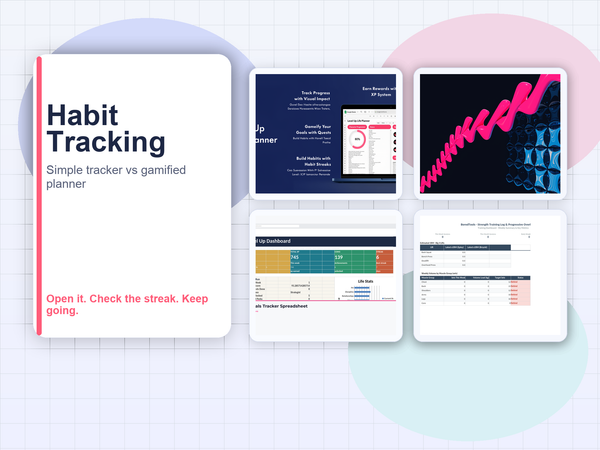
Habit Tracker Spreadsheet Template: Build Better Habits Without an App
Habit tracker spreadsheet that actually sticks. Free template walkthrough, formula tips, and top tools compared for 2026. Get the template.

From Sort & Keep, the maker of the linked templates. Our current product prices update with your selected currency. Worked examples and third-party prices keep their stated currency and date.
Here is a stat that should embarrass every habit tracking app on the market: 95% of users abandon them within 30 days. That number comes from aggregate app analytics across the productivity category, and it has barely moved in five years. The apps keep shipping new features. Users keep leaving.
A habit tracker spreadsheet solves the problem these apps created. Not with gamification, not with push notifications, not with AI-generated motivational quotes. With a grid, some conditional formatting, and a formula that tells you your actual completion rate. That is the entire product.
Choose a habit you can describe clearly and record each attempt. Review your entries over time and adjust the routine when needed. There is no fixed timetable promised by this tracker.
Why Spreadsheets Work Better Than Apps for Habit Tracking
We have tested dozens of habit tracking tools over the past two years. Apps, Notion templates, bullet journals, spreadsheets. The spreadsheet consistently wins for long-term adherence, and the reasons are not what you would expect.
The Visual Streak Effect
Jerry Seinfeld's "don't break the chain" method works because of one specific visual: an unbroken row of checkmarks. Seeing 23 consecutive days of green cells creates a psychological cost to missing day 24 that no notification can replicate. You are not responding to a prompt. You are protecting something you built.
Apps scatter this data across screens and dashboards. A spreadsheet puts your entire month on one screen. That density of visual feedback is the mechanism.
Full Customisation Without Friction
Want to track "read for 20 minutes" instead of just "read"? Add a column for minutes. Want to weight certain habits more than others? Add a multiplier. Want to separate weekday and weekend habits? Add conditional logic. Every modification is a cell edit, not a feature request to a product team that will never prioritise it.
No Notification Fatigue
A manual spreadsheet lets you choose when to record and review your habits.
Private and Permanent
Your habit data is nobody's business. A Google Sheet lives in your Drive. A local Excel file lives on your machine. Neither sends your meditation streak to a server in Virginia. No subscription to cancel. No server to go down. A spreadsheet from 2015 still opens today. Can you say the same about the habit app you used in 2022?
How to Build a Habit Tracker Spreadsheet in Google Sheets
You can build a solid habit tracker in about 15 minutes. Here is the exact structure we recommend.
Step 1: The Monthly Grid
Create a sheet for each month. Column A lists your habits (rows). Columns B through AF represent days 1 through 31. This gives you a grid where each cell is one habit on one day.
Keep it to 3-5 habits. We will explain why in the last section, but the short version is: more than 5 causes decision fatigue and tanks your completion rate.
Step 2: Mark Completions
Use a simple system. We prefer:
- 1 for completed
- 0 for missed
- Leave blank for days that have not happened yet
Numeric values let you run formulas against the data. Checkboxes (Insert > Checkbox in Google Sheets) also work and map to TRUE/FALSE, which Google Sheets treats as 1/0 in calculations.
Step 3: Conditional Formatting for Streaks
Select the entire data range (B2:AF6 if you have 5 habits). Apply conditional formatting:
- If cell = 1, fill green
- If cell = 0, fill red
This is the visual streak that drives the "don't break the chain" effect. A wall of green with one red cell sticks in your brain. You will remember it when you are deciding whether to skip tomorrow.
Step 4: Completion Rate Formula
In column AG (or the column after day 31), add this formula for each habit:
=COUNTIF(B2:AF2, 1) / COUNTA(B2:AF2)
This divides completed days by total logged days (ignoring blanks for future dates). Format as a percentage. Now you know your actual adherence rate, not a feeling about how you are doing.
Step 5: Rolling Averages
Add two more columns:
- 7-day rolling average:
=COUNTIF(OFFSET(AF2, 0, 0, 1, -7), 1) / 7 - 30-day rolling average:
=COUNTIF(OFFSET(AF2, 0, 0, 1, -30), 1) / 30
These smooth out bad days and show you the real trend. A 7-day average of 86% tells you the truth even when a single missed day feels catastrophic.
Step 6: The Dashboard Row
At the top of the sheet, add a summary row for overall daily completion across all habits: =COUNTIF(B2:B6, 1) / COUNTA(B2:B6). Copy across all day columns. Now you can see which days you tend to slip (Fridays, usually) and which habits drag down your overall score.
Habit Stacking: Record the Cue and the Activity
Most habit trackers. Apps and spreadsheets alike. Reduce a habit to a binary. Did you do it? Yes or no. This misses the mechanism that actually builds habits.
Charles Duhigg's habit loop (cue-routine-reward) and James Clear's extension of it (cue-craving-response-reward) describe how habits form neurologically. The checkmark only captures the "response" step. If you want to understand why some habits stick and others do not, you need to track the full loop.
Add three columns to your spreadsheet for each habit:
- Trigger: What cue initiated the behaviour? (e.g., "finished morning coffee," "alarm at 6:30am")
- Routine: What you actually did, with specifics ("ran 2.3 miles" vs just "ran")
- Reward: What happened after? How did you feel?
After 2-3 weeks of tracking triggers, you will notice patterns. Maybe you always meditate after coffee but never after lunch. Maybe you only exercise when you lay out clothes the night before. These patterns are the key to making habits automatic rather than effortful.
This is also how habit stacking works. You attach a new habit to an existing trigger (the completion of a habit you already do reliably). Tracking triggers reveals which existing habits are stable enough to stack onto.
Comparing Habit Tracking Approaches
Here are the main considerations.
1. Pen-and-Paper Bullet Journal
Platform: Any notebook
Price: $0-15 for the notebook
Best for: People who enjoy the ritual of handwriting
Pros:
- Zero tech friction. Open the book, pick up the pen
- No screen time; tactile satisfaction of filling in squares
- Works anywhere, no battery or internet required
Cons:
- No formulas. You are calculating completion rates manually or not at all
- Cannot sort, filter, or analyse trends without transferring to a digital tool
- No backup; if the notebook is lost, the data is gone
- Rewriting the grid layout every month gets tedious
Verdict: If you are a committed bullet journalist who already carries a notebook daily, this works. For everyone else, the manual overhead kills consistency around week 3.
2. Habit Tracking Apps (Habitica, Streaks, Loop Habit Tracker)
Platform: iOS and Android
Price: Habitica: Free (limited) / $47.88/year. Streaks: $4.99 one-time (iOS only). Loop Habit Tracker: Free (Android only).
Best for: People who want push notifications and gamification
Habitica turns habits into an RPG with XP, gold, and boss fights. Genuinely fun for about two weeks. Then you are managing a character inventory instead of your habits. Streaks is the opposite. Minimal, focused, six habits max, clean design, Apple Watch integration. Loop Habit Tracker is open-source, ad-free, and surprisingly powerful. Streak charts, frequency histograms, consistency scores. No account required, all data stored locally.
Pros (general):
- Fastest logging. One tap per habit
- Push notification reminders
- Streaks and Loop both respect privacy (local data)
Cons (general):
- Habitica's gamification is a distraction disguised as motivation
- Limited customisation. You cannot add calculated fields or custom metrics
- Most apps do not let you track the full habit loop (trigger-routine-reward)
- Data portability is poor; exporting to CSV loses context
Verdict: Streaks (iOS) and Loop Habit Tracker (Android) are genuinely good if you want simplicity. Habitica optimises for engagement, not behaviour change. None support the kind of analysis. Rolling averages, habit stacking triggers, custom weighted scores. That a spreadsheet handles natively.
3. Notion Habit Tracker Templates
Platform: Notion (web, desktop, mobile)
Price: Free (Notion free tier) to $15-25 for premium templates
Best for: People already living in Notion for other workflows
Pros:
- Beautiful layouts with toggle switches, progress bars, and embedded views
- Relational databases let you link habits to goals, projects, or routines
- Works across devices with real-time sync
Cons:
- Notion mobile app is noticeably slower than a spreadsheet. Loading time matters at 6am
- Formula support is limited compared to Google Sheets; rolling averages require workarounds
- Over-engineering is the default. Most Notion habit templates are too complex
- Requires internet connection (offline mode exists but is unreliable)
Verdict: If Notion is already your second brain, adding a habit tracker makes sense. If you are adopting Notion specifically for habit tracking, you are overcomplicating a problem that a 5-column spreadsheet solves.
4. Basic Habit Tracker Spreadsheet Template (DIY or Free)
Platform: Google Sheets / Excel
Price: Free
Best for: Anyone willing to spend 15 minutes building what we described above
Pros:
- Fully customisable. Add any column, formula, or conditional format you want
- Completion rate and rolling averages calculated automatically
- Full data ownership, works offline, no subscription
- Shareable with an accountability partner via Google Sheets sharing
Cons:
- Requires basic spreadsheet knowledge to set up formulas
- Mobile data entry in Google Sheets is functional but not delightful
- You have to build it yourself or find a decent free template
Verdict: This is what we recommend for most people. The 15-minute setup pays for itself within the first week. You get exactly the tracker you need with zero monthly cost.
5. Gamified Spreadsheet: Level Up Life Planner
Platform: Google Sheets
Price: $19.00
Best for: People who want RPG-style motivation without sacrificing spreadsheet flexibility
The Level Up Life Planner (Sort & Keep) uses points and levels to help you record habits in a spreadsheet. Check the workbook previews to see whether its layout suits the activities you want to track.
Works identically in both editions. UK version uses British English and £ formatting, US version uses American English and $ formatting. Same gamified tracking system, your preferred locale.
The key difference: you control the reward structure. You decide how much XP each habit is worth and which categories to prioritise. Habitica decides these things for you with a generic RPG framework. The Level Up Life Planner lets you build a game that maps to your actual life.
Pros:
- XP and levelling system that maps to your personal goals
- Full spreadsheet flexibility. Add formulas, custom metrics, new categories
- Streak visualisation and completion rates built in
- Life category dashboard across health, career, relationships, etc.
- One-time purchase, no subscription
Cons:
- $19 is more than a basic template (though less than 5 months of Habitica premium)
- The gamification layer adds complexity that minimalists will not want
- Requires setup time to customise XP values and categories to your life
Verdict: If the "don't break the chain" visual is not enough motivation and you want a progression system, this is the best implementation we have found. Data integrity of a spreadsheet, motivational hooks of a game, no subscription. Read the full review for a deeper walkthrough.
Get the Level Up Life Planner on Sort & Keep | Also on Sort & Keep; $25.71
The "Less Is More" Rule: Why You Should Track 3-5 Habits Maximum
This is the section most habit content skips, and it is the reason most habit trackers get abandoned.
Research on decision fatigue (Baumeister et al.) shows that each habit you track is a daily decision: did I do it? Should I do it now? Can I skip it? Track 12 habits and you are making 12 extra decisions every day on top of the actual effort.
The data supports this. In a 2020 analysis of habit tracking app usage (Stawarz et al., CHI), users tracking 1-3 habits maintained adherence for an average of 4.2 months. Users tracking 7+ habits averaged 23 days.
Here is how we recommend structuring your tracker:
Start with 3 habits. Not your 3 hardest habits. Your 3 most important ones. Importance and difficulty are different axes.
Run them for 66 days minimum. That is the average from the UCL study. Do not add new habits until the current ones require zero willpower.
Graduate habits off the tracker. Once a habit is truly automatic. You do it without thinking, and missing it feels wrong. Remove it and add a new one. The tracker is a training tool, not a permanent monitoring system.
Never track more than 5 simultaneously. If you have 10 habits you want to build, that is a 6-month project with 2 batches, not a 30-day sprint with everything at once.
This constraint is why a spreadsheet works better than most apps. Apps encourage you to add more habits because more engagement means better retention metrics for the company. A spreadsheet has no such incentive.
Which Approach Should You Pick?
Here is the honest recommendation:
If you want zero cost and maximum flexibility: Build the Google Sheets tracker from section 3 of this article. It takes 15 minutes, it works on every device, and it will outlast any app.
If you want the simplest possible app: Streaks on iOS ($4.99 one-time) or Loop Habit Tracker on Android (free). Both are private, well-designed, and respect the less-is-more principle.
If you want gamified motivation in a spreadsheet: The Level Up Life Planner (Sort & Keep) ($25.71) gives you XP, levelling, and life-category dashboards without sacrificing data ownership.
If you are already a Notion user: Use a Notion template, but keep it simple.
If you love pen and paper: Bullet journal works, but photograph each month's grid as digital backup.
The tool matters less than the constraint. Track 3-5 habits. Do it for 66 days. Review your completion rate weekly. Graduate habits that become automatic. That is the entire system. The spreadsheet is just the scoreboard.
Related Reads
- Level Up Life Planner: Gamified Spreadsheet Review
- Budget Spreadsheet Templates 2026: Compare Free and Paid Options
- Freelance Command Center: Client CRM, Time Tracking, Invoices & Tax Estimator
Get free spreadsheet templates and updates. New templates, feature updates, and practical guides delivered to your inbox. No spam, unsubscribe anytime.
Subscribe free → | Already have a template? Download the free budget tracker or free meal planner. Email required for delivery; newsletter optional.
Looking for more options? Browse our complete guide to lifestyle and planning spreadsheets.
Choose the right next step
The Level Up Life Planner is a gamified habit tracker spreadsheet for goals, habits, points and visible progress without adding another subscription.