Budget Template for New Parents: First Baby Budget Planner
Budget template for new parents covering maternity pay drops, baby costs, nursery fees, and the income shift. Get the template.

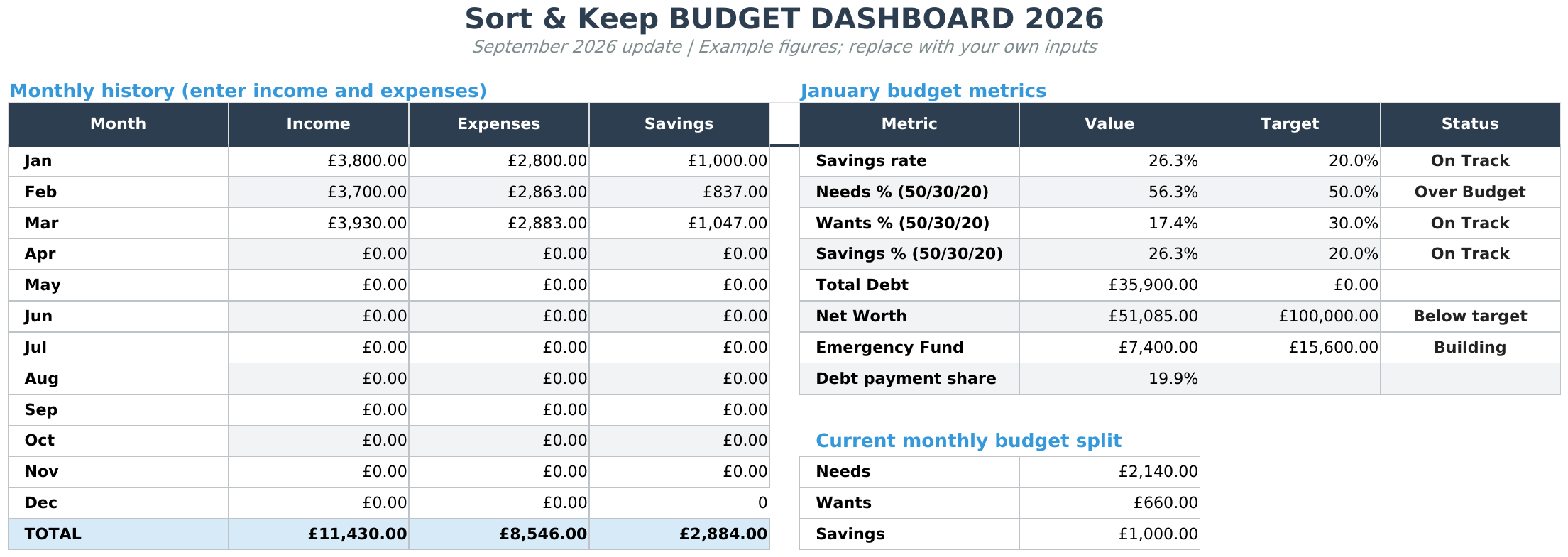
From Sort & Keep, the maker of the linked templates. Our current product prices update with your selected currency. Worked examples and third-party prices keep their stated currency and date.
Nobody tells you the real number. You hear about cots and prams and nappies, but the actual financial shock of a first baby is this: the average first-year cost in the UK runs between £6,000 and £11,000 in direct spending alone. That's before you count the income you lose.
Statutory maternity pay drops to £184.03/week after six weeks. Statutory paternity pay is the same rate for just two weeks. If your household ran on two full salaries, you're suddenly operating on a fraction of your normal income at the exact moment expenses spike. Then, if both parents return to work, nursery costs average £14,000 per year. That's more than most people pay on their mortgage.
A budget template for new parents needs to handle three distinct financial phases. Most generic spreadsheets don't acknowledge that the first one exists. The Budget Dashboard 2026 ($10.81, one-time) is built for exactly this. It models all three phases on one screen, with savings goals, a proper dashboard, and UK-specific figures baked in. Grab it on Sort & Keep →
Why You Need a Budget Template for New Parents
If you already have a working budget, whether it's a 50/30/20 template or something more detailed, it's going to stop making sense within weeks of your due date. Here's why.
Your income drops, sometimes dramatically. Statutory maternity pay is 90% of your average weekly earnings for the first six weeks, then £184.03/week (or 90% of earnings, whichever is lower) for the next 33 weeks. Some employers offer enhanced packages, but many don't. If you were earning £2,800/month net and you're now getting £797/month in statutory pay, your household income just fell by £2,000/month for the better part of a year.
Expense categories completely change. Your old budget had "dining out" and "gym membership" and "commuting." Your new budget needs "nappies" (£40-£60/month), "formula if needed" (£40-£80/month), "baby clothes they'll wear for eight weeks," and "the third muslins pack because you keep running out." The categories don't map. You can't just add a "baby" line to an existing template and call it done.
One-off costs pile up before the baby arrives. A pram (£200-£1,200), a cot and mattress (£100-£500), a car seat (£100-£300), and the endless smaller items. Bottles, a steriliser, a changing mat, nursery furniture. These hit in the third trimester, right when you're also thinking about lost income.
Childcare costs rival mortgage payments. When parental leave ends, full-time nursery costs average £14,000/year in England. Over £1,100/month. Even with the government's free hours entitlement (available from age nine months as of 2025), wraparound care and the gap before entitlement kicks in still cost a fortune. Some parents discover that returning to work barely breaks even after childcare is paid. That's a decision your budget template should help you model, not one you stumble into.
If you're managing this as a couple, our couples budget template covers the joint income mechanics. But the baby-specific financial phases below are what most couples miss entirely.
The New Parent Budget Framework: Three Phases
Forget a single static monthly budget. New parents need a plan that evolves through three distinct phases, each with different income levels and expense profiles.
Phase 1: Pre-Baby Prep Savings (Months 6-9 Before Due Date)
This is your accumulation phase. Both incomes are still flowing, but the clock is ticking.
Goal: Build a buffer that covers the income gap during parental leave, plus one-off baby purchases.
Calculate your maternity/paternity pay (more on this below), subtract it from your current household income, and multiply the difference by the number of months of leave planned. That's your target savings buffer.
Example:
- Current combined take-home: £4,500/month
- During maternity leave: £2,800 (one salary) + £797 (statutory pay) = £3,597/month
- Monthly shortfall: £903
- Planned leave: 9 months
- Buffer needed: £8,127
Add £2,000-£4,000 for one-off baby purchases. You're looking at a £10,000-£12,000 savings target. That sounds enormous. And it is. But knowing the number six months out is infinitely better than discovering it in month three of leave when the savings account is empty.
Phase 2: Parental Leave Survival Budget (Birth to Return to Work)
This is the tightest phase. Income is reduced, expenses are elevated, and the temptation to "just put it on the credit card" is constant.
Key principles for this phase:
- Strip your budget to essentials plus baby costs. Everything else pauses
- Cancel or freeze subscriptions you won't use (gym, commuting costs, dry cleaning)
- Track nappy and formula spend weekly, not monthly. Costs vary wildly in the first few months
- Don't touch the emergency fund for predictable baby costs; that's what the prep savings buffer is for
- Accept that your savings rate will be zero or negative for this period; that's planned, not failure
Phase 3: Return-to-Work Adjusted Budget (Ongoing)
Income recovers (partially or fully), but childcare costs arrive as a new permanent expense. This is the phase most parents find hardest because the numbers look like they should work. Two incomes again. But childcare eats the gap.
What changes:
- Childcare becomes your second or third largest expense line
- Commuting costs return (for both parents or one)
- Work-related costs resume (lunches, clothing, etc.)
- Some baby costs decrease (fewer nappies as they grow, potentially less formula)
- Tax-Free Childcare and free hours entitlements start reducing the childcare bill
Keep separate estimates for each phase of the change. Our Budget Dashboard 2026 does this out of the box. If you own a home and are thinking about how a baby reshapes your long-term finances, the homeowners budget template pairs well with this guide.
4 Approaches to Managing the New Parent Budget
Here's what works and where each approach falls short.
1. Banking App Budgeting Features (Monzo, Starling, Chase)
Platform: iOS, Android
Price: Free (included with the bank account)
Most modern banking apps now include spending categories, pots or spaces, and basic budgeting. Monzo's "Summary" and Starling's "Spaces" are the most popular.
Pros:
- Automatic categorisation. No manual entry
- Spending pots help ring-fence baby costs and savings
- Already in your pocket
Cons:
- Only tracks spending in that one account. Useless if you have multiple accounts or a partner with a different bank
- No way to model future phases (maternity pay drop, childcare costs)
- Categories are generic. No "nappies" or "nursery fees" breakdown
- Can't track Child Benefit or Tax-Free Childcare separately
Verdict: Check whether the tool can show future changes in income and compare childcare costs, as well as record day-to-day spending.
2. Dedicated Budgeting App (YNAB, Emma, Plum)
Platform: iOS, Android, Web
Price: YNAB $14.99/month; Emma Pro £4.99/month; Plum Pro £2.99/month
Full budgeting apps with category customisation, goal tracking, and (in some cases) bank connections.
Pros:
- Customisable categories. You can create "Nursery Fees" and "Nappies" as separate lines
- YNAB's "envelope" method works well for the tight Phase 2 budget
- Goal tracking helps with the pre-baby savings push
- Multi-account support
Cons:
- Recurring cost at the worst possible time. YNAB is £150/year
- Learning curve when you're already overwhelmed
- None of them have maternity pay calculators or childcare comparison tools built in
- Partner sharing is limited or requires separate subscriptions
Verdict: YNAB is genuinely excellent if you're already using it. Starting it fresh while pregnant is a hard sell. The learning curve and the subscription cost both work against you. Emma and Plum are lighter but less capable for the detailed phase planning new parents need.
3. DIY Google Sheets Spreadsheet
Platform: Google Sheets (free)
Price: Free
Setup time: 1-2 hours
Build a multi-tab spreadsheet: Phase 1 savings plan, Phase 2 survival budget, Phase 3 return-to-work budget, and a baby cost tracker.
Pros:
- Completely free and fully customisable
- Can model all three phases with different income assumptions
- Shareable with your partner. Both of you edit the same sheet
- Formulas handle maternity pay calculations, childcare comparisons, anything you need
Cons:
- Significant setup time. You need to build everything from scratch
- Easy to break formulas, especially when sleep-deprived
- No templates for the baby-specific calculations unless you find one online
- Manual data entry for everything
Verdict: The most flexible option, but the setup cost is real. If you enjoy spreadsheets, start building in the second trimester while you have the mental bandwidth. If formulas aren't your thing, you'll abandon it within a fortnight.
4. Pre-Built Budget Spreadsheet Template
Platform: Google Sheets
Price: Free (basic) or $10.81 (full dashboard)
A ready-made spreadsheet with income tracking, expense categories designed for real households, savings goals, and a dashboard. Without building anything from scratch.
Pros:
- Ready to use in under 10 minutes
- Structured categories you can customise for baby costs
- Savings goal tracking with progress. Perfect for the Phase 1 buffer
- Works on mobile via the Google Sheets app
- One-time purchase, no subscriptions
Cons:
- Still requires manual data entry
- No automatic bank connection
- You'll want to add baby-specific category labels yourself
Our Free Budget Tracker handles the basics: income, expenses, and a monthly overview. It's enough to get through Phase 2 if you add a few baby-specific expense lines. For the full three-phase plan, with savings goals for the pre-baby buffer, debt tracking, a proper dashboard, and a yearly overview, the Budget Dashboard 2026 ($10.81, one-time) gives you the structure without any subscription. Get the Budget Dashboard 2026 →
UK edition built for British finances. HMRC Self Assessment categories, council tax tracking, National Insurance (Class 2 and Class 4) calculations, ISA allowances, and GBP formatting throughout. US edition included with IRS tax brackets, 401(k) tracking, and USD formatting.
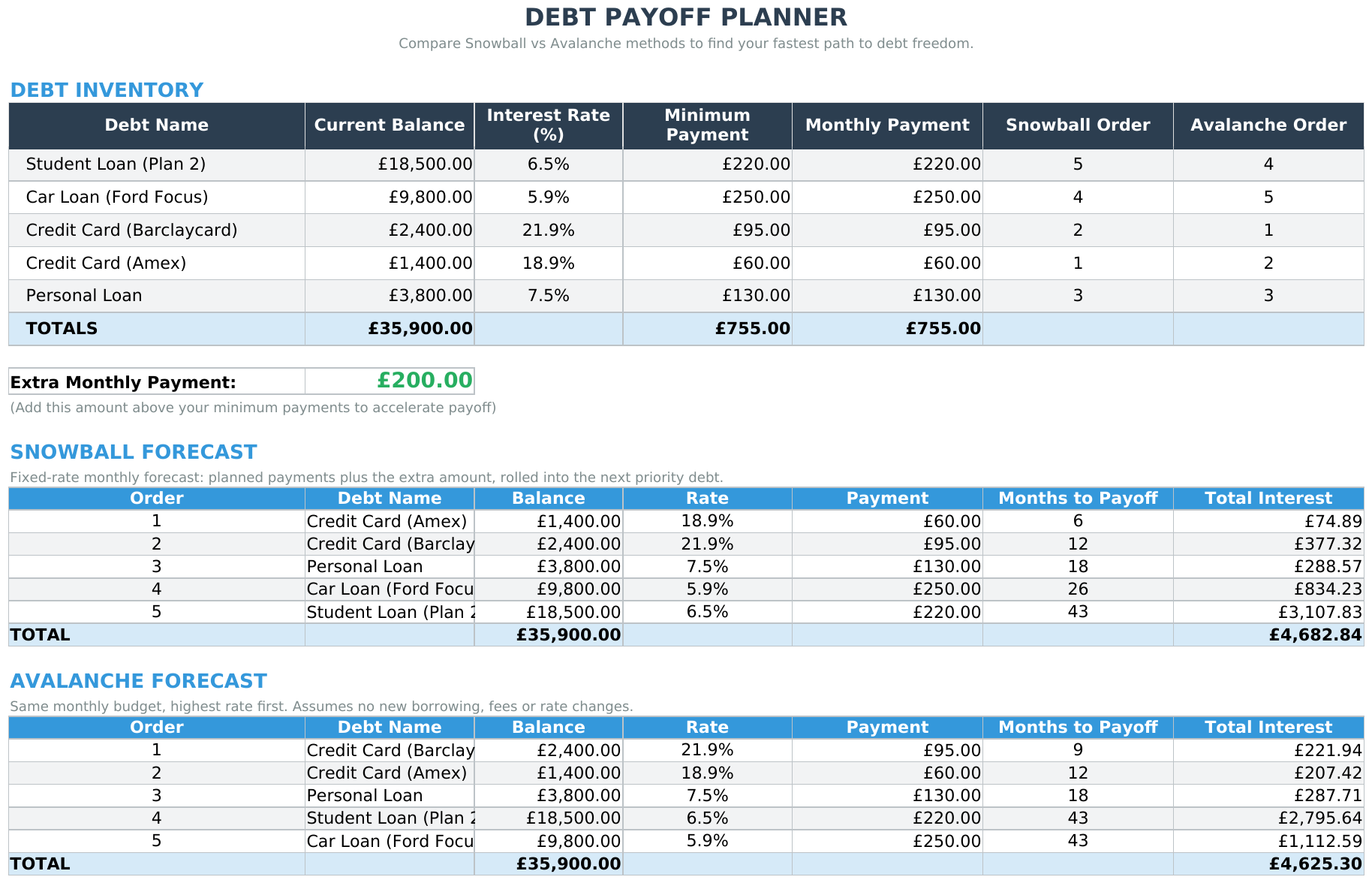
Break out baby costs as individual line items. Nappies, formula, clothing, nursery fees. So you can see exactly where the money goes each month.
Verdict: Best balance of speed and flexibility for new parents. You get a working system on day one but can adapt it as you move through each phase. Add custom categories for maternity pay, baby costs, and childcare, and you've got a template that actually matches your life.
Features a Budget Template for New Parents Must Include
Whatever tool you use, make sure it covers these. They're the details that separate a generic budget from one that actually works for the first two years of parenthood.
Maternity and Paternity Pay Calculator
You need to know exactly what your income will be during leave. Not a rough guess, the actual number.
Statutory Maternity Pay (2025-26):
- Weeks 1-6: 90% of your average weekly earnings (no cap)
- Weeks 7-39: £184.03/week or 90% of earnings, whichever is lower
- Weeks 40-52: unpaid
Statutory Paternity Pay:
- 1 or 2 weeks: £184.03/week or 90% of earnings, whichever is lower
Enhanced pay: Many employers offer better packages. Three months at full pay, six months at half pay, etc. Check your contract and model the exact month-by-month income in your spreadsheet. The difference between statutory-only and an enhanced package can be £5,000-£15,000 over the leave period.
Build a row-per-month income projection from three months before due date through to six months after returning to work. That's your income reality, and everything else flows from it.
Child Benefit Tracking
Child Benefit for your first child is £25.60/week (£1,331/year). It's paid every four weeks, not monthly. So some months you receive one payment and others you get two. Over a year, that's 13 payments.
Important: If either parent earns over £60,000, the High Income Child Benefit Charge claws back some or all of it. Between £60,000 and £80,000, you lose 1% for every £200 over £60,000. Above £80,000, you lose it all. Still register for it. It protects your National Insurance record even if you repay the cash amount.
Map the four-weekly payment dates into your budget so you know which months get the extra payment. That "bonus" month is a good time to top up the savings buffer.
Tax-Free Childcare Account
The government tops up childcare payments by 25%. For every £8 you pay in, you get £2 added, up to £2,000 per child per year (£500 per quarter). That's real money: £2,000/year off nursery fees.
But you have to actively pay into the account each quarter to trigger the top-up, and any unused quarterly allowance doesn't roll over. Your budget needs a quarterly reminder to maximise contributions. Missing one quarter costs you up to £500 in free money.
Note: You can't use Tax-Free Childcare and childcare vouchers at the same time, and it affects your Universal Credit calculation. If you're on UC, check which option gives you more. The childcare element of UC covers up to 85% of costs (capped at £1,014.63/month for one child).
One-Off Baby Cost Tracker
The pre-baby spending spree deserves its own tracking section. Here's a realistic breakdown:
| Item | Budget Range | Notes |
|---|---|---|
| Pram / travel system | £200 - £1,200 | Buy secondhand if budget-conscious; the baby won't know |
| Cot and mattress | £100 - £500 | New mattress recommended even with secondhand cot |
| Car seat | £100 - £300 | Don't buy secondhand (safety standards, unknown history) |
| Clothing (0-12 months) | £150 - £400 | They grow out of everything in weeks; accept hand-me-downs |
| Bottles and steriliser | £30 - £80 | Only buy a few initially; babies are fussy about brands |
| Nappies (first year) | £500 - £800 | Roughly £40-£65/month depending on brand |
| Formula (if needed, first year) | £500 - £1,000 | £40-£80/month; breastfeeding saves this entirely |
| Nursery furniture | £100 - £600 | Changing table, storage, blackout blinds |
| Miscellaneous | £200 - £500 | Muslins, bibs, bath stuff, monitor, random Amazon 3am purchases |
Total one-off + first year consumables: £1,880 - £5,380
Track each purchase against the budget. It's easy to overspend on the pram and then have nothing left for the twelve other things you need.
Nursery vs. Childminder Cost Comparison
When parental leave ends, this is the biggest single decision in your budget. Model both options side by side:
| Full-time Nursery | Childminder | Nanny Share | |
|---|---|---|---|
| Average monthly cost | £1,100 - £1,300 | £800 - £1,000 | £700 - £900 per family |
| Free hours eligible | Yes (from 9 months) | Yes (if registered) | No |
| Tax-Free Childcare eligible | Yes | Yes (if registered) | Yes (if registered) |
| Flexibility | Fixed hours, penalties for late pickup | Often more flexible | Most flexible |
| Holiday cover | Open year-round (most) | You pay during their holidays too | Shared arrangement |
The annual difference between the cheapest and most expensive option can be £4,000-£6,000. That's worth spending an hour modelling in a spreadsheet.
Putting It All Together
Here's the honest summary of budgeting as a new parent: the money is going to be tight, and pretending otherwise doesn't help. What does help is knowing exactly how tight, exactly when, and for exactly how long.
The three-phase framework turns vague dread into a concrete plan. Phase 1 gives you a savings target you can work toward while both incomes are still flowing. Phase 2 gives you a stripped-back survival budget that stops you reaching for credit cards in a panic. Phase 3 gives you a realistic picture of life after parental leave, including whether full-time work, part-time work, or a different childcare arrangement makes the most financial sense.
Start with the Free Budget Tracker and add your maternity/paternity pay projections, baby cost estimates, and Child Benefit income. If you need savings goals with progress tracking, a proper dashboard, and a yearly view that lets you see all three phases on one screen, the Budget Dashboard 2026 ($10.81, no subscription) handles all of it. Grab it for $10.81 on Sort & Keep →
If you're doing this solo, our single parents budget template covers the one-income-specific details in depth. For the joint income mechanics and proportional splitting, the couples budget template pairs well with the baby-specific framework in this guide.
The numbers are what they are. Knowing them early, tracking them honestly, and claiming every penny you're entitled to. Child Benefit, Tax-Free Childcare, free hours, employer-enhanced pay. That's how new parents get through the expensive first years without spiralling into debt. The spreadsheet doesn't make it easy. It makes it manageable.
Related Reads
- Budget Template for Single Parents (one-income-specific budgeting with child costs)
- Budget Template for Couples (proportional income splitting and shared goals)
- Budget Template for Newlyweds: Merging Finances After the Wedding
- Budget Spreadsheet Templates 2026: Compare Free and Paid Options
Get free spreadsheet templates and updates. New templates, feature updates, and practical guides delivered to your inbox. No spam, unsubscribe anytime.
Subscribe free → | Already have a template? Download the free budget tracker or free meal planner. Email required for delivery; newsletter optional.
Choose the right next step
Need a simple budget tracker spreadsheet? Start with the Free Budget Tracker. Use Budget Dashboard 2026 when you want budgets, debt, savings and net worth in one workbook. Choose the Complete Collection when several parts of life admin need sorting.